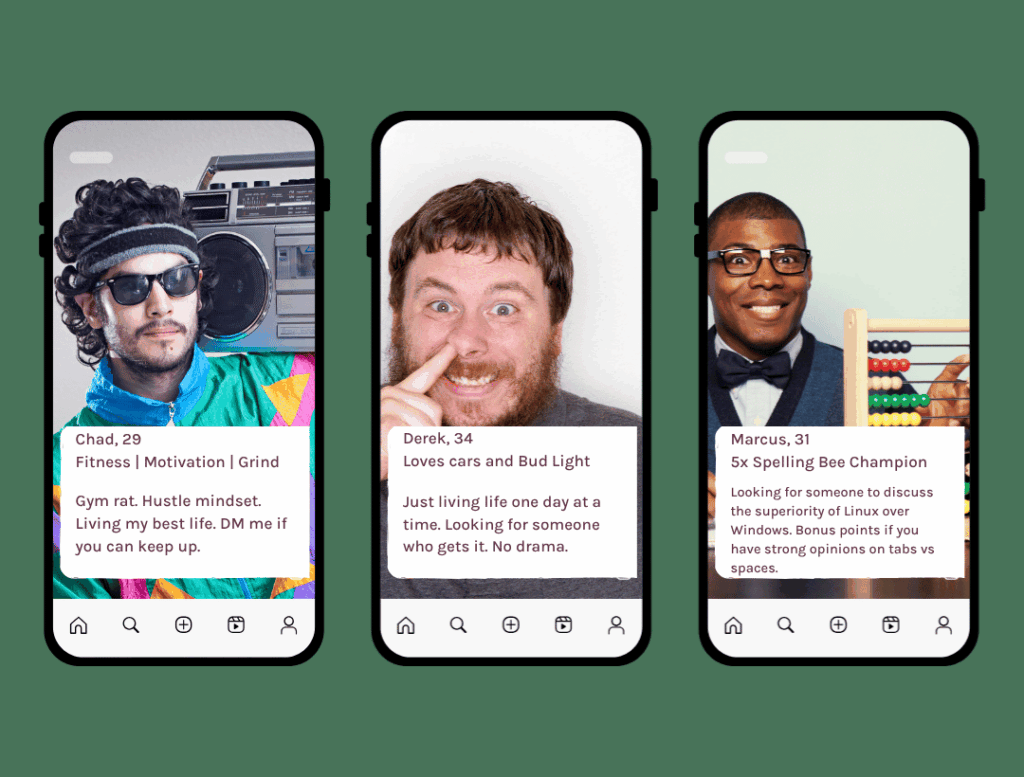
Do you really have multiple target audiences?
Ask and you shall receive.
I sent out a survey a few weeks back and asked: If I could write a newsletter just for you, what’s the one topic you’d want me to cover?
The same answer kept showing up. What do I do if I have more than one target audience?
This has also come up in 4 of my last 6 discovery calls and in every workshop I’ve run over the past year.
So let’s talk about it.
(Even if you don’t have multiple audiences, there’s some good stuff below that you’ll find applicable–so maybe don’t peace out yet.)
Before we go further, I want you to consider why you have multiple audiences. Because sometimes people tell me this and they actually shouldn’t be trying to talk to multiple audiences.
But maybe, like many of you, you call yourself multi-passionate or a multi-potentialite, which means you legitimately do have multiple target audiences. And that can pose a real problem.
For some of you, you might only have one offer, but it makes sense for more than one audience, which also presents challenges.
The last thing to consider before we dig in: I think there’s confusion around the terms “target audience” and “ideal client.” So let’s start there.
Target audience vs. ideal client
Here’s an analogy I actually kind of hate, but it makes the most sense here, so I’m using it anyway.
Picture all the possible people in the world as fish swimming in one big ocean. There are multiple schools of fish whose problems you could solve. But there’s really one or two specific fish whose problem you’re best suited to solve.
Those schools of fish are your target audience. Those one or two fish are your ideal client.
And to complicate this even more, your target audience isn’t just made up of potential clients. It’s made up of everyone you could be speaking to. Sometimes I’m speaking to people I call amplifiers. They’ll likely never buy from me, but they’re the ones who say my name when I’m not in the room. They refer me and help spread my message.
Your audience might include a myriad of categories, like investors. They’re not going to buy from you, but they need to understand what you do and why they should back your business. That message looks different than the one for your other audiences.
So first let’s figure out which version of this problem you have, and what to do about it.
Problem #1: You don’t have a multiple audience problem. You have a decision problem.
Let’s start with me, because I know many of you are in the same situation.
I help businesses like yours figure out what genuinely makes you different in a way your ideal clients actually care about, so you can clearly set yourself apart in the market.
That need applies to literally any business owner. I could serve B2B, B2C, B2G, coaches, consultants, you name it. Just because I can serve all of those roles and industries doesn’t mean I should.
It might seem like casting a wider net gives me more options. But each of those groups needs to hear something different, because the way they experience the problem shows up differently in their day to day.
If I want to actually help the people I’m best positioned to help, I need to clearly tell them why they should choose me. And if I’m trying to speak to everyone, I dilute the message. When you market to everyone, you market to no one.
Here’s what I mean:
❌ We help software companies grow.
This is vague. It skips the problem entirely and jumps straight to a generic outcome, which means it could describe almost any company in the space. No one reading it feels “caught,” because there’s no specific moment or struggle they can recognize as their own.
(This is exactly why I hate this analogy. People aren’t bait. If you’ve got a better option, please let me know!)
✅ We help vertical SaaS founders under $2M ARR land their first 10 enterprise logos, after a board member asks how they’re planning to land enterprise deals and they realize they don’t have a real answer.
This is specific. It names the exact founder, the exact moment things got uncomfortable, and the exact outcome they need. Anyone who’s sat in that board meeting will feel seen and understood.
Instead of casting a wider net, you position yourself to catch that one specific fish.
If this feels like you, you don’t have a multiple target audience problem. You have a decision to make. And the good news is that’s usually a fast fix. Sometimes we nail it down in one Clarity Call.
Problem #2: You genuinely serve two audiences.
Now let’s say you have one offer that genuinely serves two audiences.
I worked with a client whose vision is “A future where families and schools work together to raise confident, compassionate kids who thrive in school and in life.” They have two ideal clients: families, which is B2C, and schools and school districts, which is B2G.
Quick side note. I serve B2B businesses primarily, but everything I just said still resonated with them. Positioning myself the way I do didn’t exclude them. The right people still found me.
Their situation was complicated.
Most people go wrong here by starting with: What do these two audiences have in common? What do they both need to hear? Who else serves both families and school districts?
That seems like the most effective approach. It’s not.
What you actually need to do is start by treating them as two distinct audiences. You already know this intuitively, because you’re the one telling me you have multiple audiences. You’re just not strategizing that way yet.
First, we looked at families alone.
- Who else serves them?
- What options are they considering?
- What’s keeping them up at night?
- What do they actually need?
Then we did the same thing for schools and school districts, on their own.
Only after that could we look for the through line. What position could they take that differentiated them to both audiences, specific enough to speak to each one, broad enough to hold both?
This is what I mean when I say your positioning is the foundation of everything else. Once they had that piece figured out, we could get into what each audience needed to hear. Only after that did they touch anything tactical, like their website.
“She skillfully helped clarify our target audiences and sharpen our messaging in a way that aligns with our mission while expanding our reach. Thanks to her guidance, we now have a sharper focus, stronger positioning, and a clear path toward sustainable growth.” – Kristin Nori, InspireEd Solutions
It started with the positioning work. It always does.
Problem #3: You have multiple businesses or multiple offers.
This is the trickiest group.
When your businesses can’t share a voice
A prospective client once came to me wanting to figure out how to stand out competitively in the market. I told him I wasn’t the right fit for the approach he wanted to take and suggested another one.
He had three very distinct businesses, and wanted me to help him build one personal brand that incorporated all three, find the handful of key messages that would resonate across all of them, so he could build one website. The person he pointed to as his inspiration was Jesse Itzler.
Here’s why that didn’t work. Jesse didn’t start as a serial entrepreneur, he started as a rapper, before building Marquis Jet, then ZICO, then a stake in the Atlanta Hawks, two bestselling books, and a speaking career. All of it lives under one name because he built an audience first, in one lane, then let the rest layer on.
My prospective client wanted all three businesses to launch and speak with one voice on day one. That’s not what Jesse did, and it wasn’t going to move his buyers toward a yes.
You can still build one brand. You just can’t conflate three businesses under it.
The only real throughline across multiple businesses is usually you: your values, your story, your lived experience. How you position and speak to each business still needs to be distinct.
This is genuinely one of the most nuanced problems in this whole newsletter, so I’m giving it its own deep dive. [Watch/read: how to build one personal brand across multiple businesses →]
When your businesses can share a throughline
A new client of mine has an existing communications and brand strategy agency that’s established and successful. But she’s now branching out on her own, also taking on solo consulting work and speaking.
Her situation is different, because the problem she solves is similar across both. She applies the same framework either way. With her consulting, she can go deeper and broader. But she can position herself in a way that speaks to, and resonates with, both ideal client profiles.
You can’t start with the website or figuring out what to post about next. You have to start with how you position yourself in the market and what sets you apart. That’s harder when you have two audiences, but it’s not impossible. Find the messaging through line that applies to both, then figure out the distinct messages each one needs to hear. Only then decide how and where you show up.
So now what?
You now know which of these three problems is yours.
If it’s Problem #1, the fix starts with narrowing, not adding.
Pull up every client you served over the past year. Who did you love working with? Who got the best results, and what did they have in common? That overlap, not the full list of who you’re capable of serving, is where your real positioning starts.
If it’s Problem #2 or Problem #3…
Look at everywhere you currently show up: your website, your social bios, your podcast intro, your proposal template. Read it as if you were each of your audiences. Could it apply to every one of them without changing a word?
Yes? Congrats, you’re on the right track.
No? Well now you know where to start. The problem is the through line you haven’t found yet (or the one you’re trying to make fit). And no amount of better social posts or headline tweaks will fix it until you do.
If you need help with this, or if you know which problem is yours and want help with the next step, that’s exactly the kind of problem we can tackle during a Clarity Call.
Until next time,

Stacy
| P.S. If you still have questions about this topic, hit reply and send them my way. I’ll either send you a personalized answer or use it as content for my next newsletter or YouTube video. (But I’ll reply either way.) If there’s another topic you’d love for me to write about, tell me here. |

When you’re ready…
1. Pitch decks don’t sell. Stories do. Earn trust with my story-first case study guide.
2. Clarity call: Not sure what’s working? Get clarity on the problem that’s been spinning in your head. (One client called it “therapy for her brand.”)
3. Website copy audit: Get a fresh set of eyes on your website, sales page, or key asset. You’ll walk away with a prioritized roadmap of what to fix first and how to fix it.
4. 1:1 positioning, messaging, & copy projects Curious if it’s a good fit? Let’s chat. (Don’t worry. It’s just a conversation. No pressure or hard pitch.)