The dart frog principle: Why playing it safe is killing your brand
My whole life, I’ve felt like I never quite fit in anywhere. I’m the proverbial black sheep of my family. And even in the places where I do fit, there’s always something a little off. Like I’m an oval peg in a round hole.
My son asked me a few years ago if I was popular in high school.
Sort of. I got invited to the parties. Some of the popular kids were friends of mine. But so were the skaters, the nerds, the goths, and everyone in between. One of my closest friends aspired to be president of the United States (back when that still meant something). Another got expelled.

I’ve never had a problem going against the grain. A lot of people aren’t okay with that. And I’ve been thinking about why.
Why we’re wired to blend in
Think about why fish swim in schools, or what happens to the sheep that strays too far from the flock.
There’s a pull we feel to fit in, to go along, to not be perceived as different or strange or wrong. I see it constantly in my work, even with clients who swear they want to stand out.
Herd mentality is a survival instinct, not a personality flaw. We are literally wired to group ourselves with others. So putting yourself out there and boldly claiming the thing that sets you apart? That can be scary as hell.
Here’s the conundrum.
Intellectually, we all say we want to be known for one thing. We know that’s how you stand out in a crowded market. But when it comes time to actually claim it, something stops us.
The case for being the dart frog
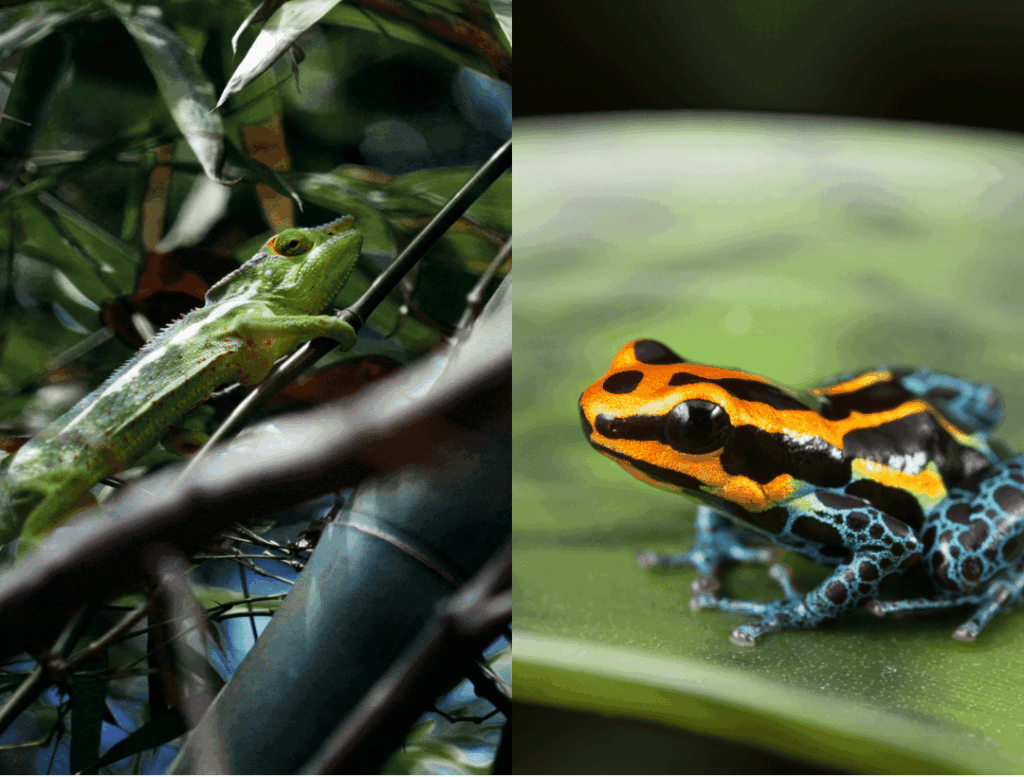
Chameleons change color to blend in. In the wild, these are smart adaptations. There’s actual evolutionary biology behind them—the dilution effect, where being one of many reduces your individual odds of becoming someone’s lunch.
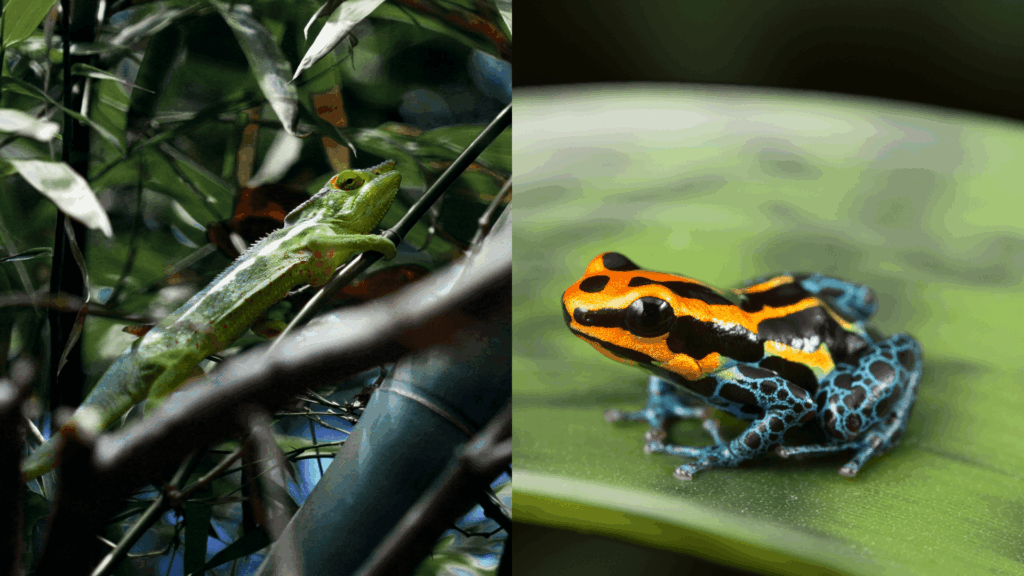
But poison dart frogs don’t dilute. They advertise. Their aposematic coloring—those vivid reds and yellows and blues—is a direct signal to predators: don’t touch me.
Both strategies work. Both are adaptive. They’re just built on opposite premises.
Blending in says don’t notice me.
Being the dart frog says notice me, and remember what that means.
In the wild, blending in has real advantages. In a saturated market? It might be the exact thing that kills your business. Warning predators away requires you to trust that your poison is actually your protection.
The question is: which one do you want to be?
What “onlyness” is and why it matters
Before we get into how you actually find your poison, let’s talk about what we’re really after here: your “onlyness.”
April Dunford calls it your differentiated value. Katelyn Bourgoin talks about being an idea owner. These are different lenses, but really the same idea.
Onlyness is the specific position in the market that only you can claim. You don’t have to invent something new. It’s about the unique intersection of your life experiences, who you serve, what you believe, and how you work. It’s the thing you can own so completely that your name and that idea become synonymous.
Here’s what claiming it actually does.
→ It makes the decision easier for your buyer. When your positioning is clear, the right people self-select. They don’t need to be convinced; they just need to find you.
→ It gives your marketing a spine. Your copy, your content, your offers all have something to orient around. Without it, everything feels disconnected.
→ It commands a premium. Commodities compete on price. When you’re the only one who does what you do, the way you do it, for the people you serve, price becomes a much smaller part of the conversation.
So when we come back to how scary it feels to separate yourself from the crowd, the real question is this:
Is playing it safe actually keeping you safe? Or is it killing your chances of being chosen?
The three-legged stool of positioning
Now, you may be thinking: I’m convinced. So how do I actually figure this out?
Look, I’ve heard that before. People say they want to stand out. Then it comes time to disrupt the status quo, and it’s a different story. More on that in a minute.
First, let me walk you through what finding your onlyness actually looks like. I call it the three-legged stool of positioning. You need all three legs. (We all know what happens to a two-legged stool.)

It’s centered around these 3 ideas:
Know your brand
Knowing your brand goes deeper than most people expect. It means getting clear on your purpose, your mission, your values, your voice—and critically, the lived experiences that shaped how you see problems and how you think differently than everyone else with a similar title, even when you don’t realize you’re doing it.
Know your competitors
Knowing your competitors is where humbling things happen. The thing you were convinced made you different? There’s a solid chance someone else is already saying it. Competitor research isn’t about copying; it’s about finding the white space.
Know your audience
Knowing your audience means really knowing them, not the version you think you know because you were once in their shoes. The research that actually moves the needle comes from getting out of your own head and into theirs. Talk to them. Listen to the language they use. When your messaging isn’t resonating even though it feels clear, this is almost always why.
Why you’ll want to soften it (and why you shouldn’t)
So once I do this work and bring it back to clients, here’s what almost always happens. They light up. We’ve hit on something they’ve never been able to articulate before.
And then… sometimes this happens:
“Wait, I’m not sure we can actually say that.” “That’s exactly it, but I’m a little worried it’s not what people expect.” “I love it. But maybe it’s a little too bold.”
Sit with that for a second. You spent real time and effort figuring out the one thing that makes you genuinely different. And when you find it, your first instinct is to soften it.
That’s a byproduct of evolution. The same wiring that kept your ancestors safe in a group is now working against your positioning strategy.
There’s an inherent cost to fitting in. The larger the group, the more intense the competition for food or resources. Or in your case, clients.
There’s another layer underneath it, though. Claiming your onlyness isn’t just a marketing decision. It’s an identity statement. And committing to one thing means implicitly releasing the others. That’s a different kind of scary. It’s not “what will people think?” It’s “what if I pick the wrong one?” or “what if I’m more than one thing?” or “what if I claim it and then change?”
Which is why this work almost always requires an outside perspective. Not because you’re not smart enough to figure it out alone, but because you’re too close to yourself to see it clearly. Your lived experiences feel ordinary to you. Your point of view feels obvious. The thing that makes you genuinely different has a way of being the last thing you’d think to mention.
But your onlyness isn’t something you think your way into. It’s something you research, claim, and commit to—especially when it feels a little scary to say out loud.
The dart frog doesn’t get to be the dart frog by blending in.
Ready to go deeper?
If you want more of this, I’m working on a video about knowing your competitors. Head over to my brand new YouTube channel and hit subscribe so you see it when it’s live!
Until next time,
Stacy