Welcome! Over the next 14 weekdays, you’ll get one actionable growth move from a different expert. No fluff, just stuff you can actually use.
👉🏻 Don’t want daily emails? Switch to weekly here.
🏃🏻♀️➡️ Catch up on past issues here.
📅 Mark your calendar for the bonus Q & A on Oct. 6th at 11am ET. (Invite to come at the end of the series.)
You posted something you were genuinely proud of, and got absolute silence. You immediately conclude the post didn’t work, or maybe this kind of content doesn’t work, and you start posting less.
Alison Knott would stop you right there. If what you offer is nuanced, or the kind of thing your audience won’t publicly admit they need, silence isn’t a verdict of your content’s worth. All it means is that your audience may see it (and even agree!) but aren’t comfortable engaging with it.
How it works
Alison defines nuanced two ways: offers where the client might feel vulnerable admitting they need it (think executive coaching), or subjects that are just high-stakes or taboo in your industry (think digital transformation). Either way, the content is the same problem: your audience agrees, but won’t say so out loud.
Alison’s fix starts with a quick audit of what you’ve already posted: is it low stakes enough that a reader could react, comment, or DM you back without it feeling risky? That’s the real lever. Ease the barrier to entry and silence turns into private engagement instead.
Why it works
For anyone selling transformation, especially big-ticket, multi-stakeholder work, your audience often agrees with everything you’re saying and still won’t comment. Commenting is a public signal they’re not ready to send.
Leaning into “ally mode” over “educator mode” changes the impact without decreasing your credibility. Finger-wagging content, however well-meant, still centers what’s wrong with the reader. Content that acknowledges what they’re already carrying, and invites a private next step, is what actually builds the trust that gets someone into a DM, a newsletter reply, and then, eventually a call.
Expect that timeline to track your sales cycle. For higher-ticket or nuanced offers, 3 to 6 months of attribution signals is normal, and 30 days is too short a window if you’re working with clients over 12.
Results
- More confidence in your DM skills: Clients stop expecting an immediate “I love this, let’s book a call” and start noticing smaller signals of interest instead. Following up on those signals, framed around the content instead of the pitch, has led to speaking invites, event invites, and discovery calls, often within 4-6 message exchanges.
- One client doubled their newsletter subscribers in under 60 days, in part because they took the time to adjust messaging to focus on the goals of their audience and positive strides made within their sector.
- A clearer read on ‘what’s working’ in your marketing: Tracking signals beyond comments shows the real timeline from “stranger who follows you” to “trusts you enough to talk,” which matters most when sales cycles are long or involve multiple stakeholders. One client found it took about three weeks after an event for people to redeem a coupon code, a pattern she never would have caught looking at comments alone.
How you can do it
What you can knock out on your lunch hour
- Pick one piece of content you’re proud of. Read it with fresh eyes and ask three questions:
- How do I want someone to feel after reading this? It should usually be some version of seen and understood, not moved to act. If your honest answer is always ‘I want them to book a call’, you’re writing for your business goals without regard to their safety. Example:
Before: I want them to feel confident enough to book a call to discuss the problem with their sale’s team performance issues.
After: I want them to feel validated by knowing this specific issue is common for teams in their position because ____. And that there are solutions if they __.
- Am I positioning myself as a trusted ally, or a finger-wagger? Even with the best intentions, teasing pain points, FOMO, and underscoring what’s going wrong in content can be a total trust killer. Example:
Before: “These are 3 most common mistakes I see executive directors make: 1________ 2_________ 3_________”
After: “As a busy executive, I know you’re working hard to: 1_________ so that you can _________ 2_________ because it was important to _________ 3_________ because you want to ________
- Is my call to action actually safe? If the ask is “book a call,” that’s often too big a leap for someone who isn’t ready to be seen taking it. A safer ask is something they can do ‘in private’: investigate a part of your framework and reflect on it on their own time, join your newsletter, or mention a resource that helps and they can DM you a word to get it (yes, this still works in 2026) .
Before: “If you’re dealing with overwhelm in your operations, book a no obligation call to explore how I can help.”
After: “If you’re dealing with overwhelm in your operations, you’re not alone. My clients have found this one question very helpful in sorting priorities. Feel free to use it:___________?”
2. Edit and then post it again. Most of your audience probably hasn’t seen it yet. Those that have probably won’t notice, and could possibly be more receptive to it a second (or third!) time around.
When you have more time, here’s where it goes next:
3. Build scenario-based content. Instead of naming a specific client situation, sanitize the details into a relatable micro-moment. This matters even more if you’re under NDA, or if clients are proud of the result but don’t want anyone knowing they had the problem in the first place.
4. Show up where your audience already is. Go to the events they go to. Repost the people they already trust. It signals you’re in the room with them, not observing from outside it.
5. Redefine what engagement looks like for you. In the absence of likes and comments, track impressions, follower growth, DM conversations, and offline mentions, or someone bringing up your content in person or at an event. The rest are reading, and some of them are the ones who’ll eventually write you paragraphs in a DM.
6. Practice curiosity instead of pitching. Start conversations with people in your audience without an agenda, ask about their priorities, share a resource or a connection that has nothing to do with booking a call. Alison’s take: your curiosity is probably what got you into this expertise in the first place, before you started defaulting into fixer mode.
Tools
- Don’t overcomplicate this or you won’t keep up with it. Alison recommends a simple table to track your metrics once a month. Here’s an example you might have for LinkedIn:
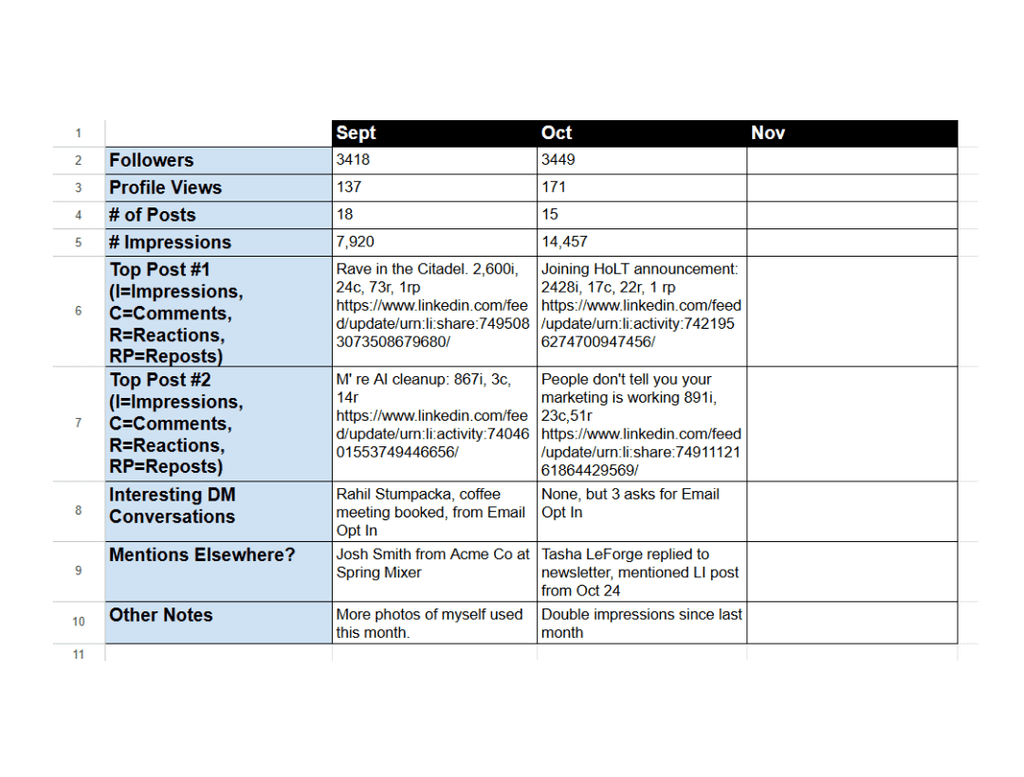
If Adriana’s tip got you republishing what you already have, this is the filter for making sure it’s actually landing with an audience that won’t tell you either way, and Renee’s Day 12 tip will pick the thread back up with a look at storytelling.
See you tomorrow with a sales tip,
Stacy
P.S. Alison helps B2B service providers in sensitive or high-stakes niches—think executive coaching, IT, anything taboo to talk about openly—attract clients who are hard to market to. Find her on LinkedIn or subscribe to Marketing Snacks.