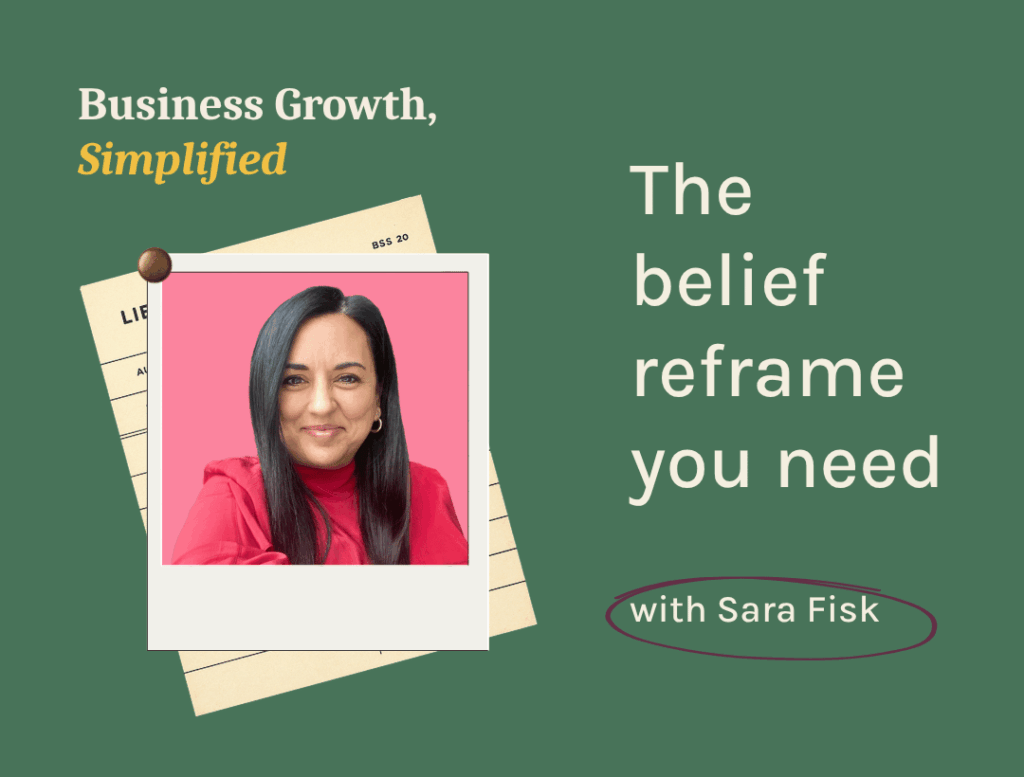
Welcome! Over the next 14 weekdays, you’ll get one actionable growth move from a different expert. No fluff, just stuff you can actually use.
👉🏻 Don’t want daily emails? Switch to weekly here.
🏃🏻♀️➡️ Catch up on past issues here.
📅 Mark your calendar for the bonus Q & A on Oct. 6th at 11am ET. (Invite to come at the end of the series.)
You’re driving to your mother-in-law’s house, and you can feel the dread building with every turn. Before you’ve even parked the car, your shoulders are up around your ears. By the time you knock on the door, you’ve got a tension headache.
This happens in your business too. It just may not be as obvious:
- The sales page you sit down to write, and the moment you open the doc, something in you goes I hate this.
- The client call where you’re going to tell them you’ve raised your rates, but reorganized your paper clips instead of thinking about what you’ll actually say.
- The doctor’s appointment you “haven’t gotten around to,” except you have time for everything else this week.
- The feedback conversation with a contractor whose work isn’t cutting it, but you get knots in your stomach every time you think about the possible fallout
There’s the same thing underneath each of these: an automatic thought running the second before you’d normally start, something like “I hate this” or “this is going to go badly”. That thought, not the task itself, is what makes you rush through it, avoid it, or do it in a way you’re not proud of.
Sara Bybee Fisk, a Master Certified Coach, has spent eight years watching that pattern play out with her clients. Most people carry it around as a Scarlet Letter, I’m just bad at hard things, like it’s who they are. Sara calls it a missing skill instead: catching that automatic thought and swapping it for one that’s also true but actually helps you move, before the moment you’re back in it.
How it works
The pattern shows up as pressure and tension right before you’d normally start: overexplaining, stalling, rushing through it, or doing it half-resentfully. Sara’s exercise has two moves. First, name the automatic thought driving it. Second, write a competing belief, one that’s still true, but that actually helps you instead of working against you.
Here’s what that actually looks like. Sara sits down to write a sales page, and the automatic thought shows up before she’s typed a word: “I hate this.” She doesn’t try to argue herself out of it, because it’s true. Instead, she adds a second true thing next to it: “I hate this, and it’s a necessary step for me to take right now.” Or: “I hate this, and I’m actually learning how to get better at it.”
The goal of the competing belief isn’t to erase the first thought; it just gives you something else true to hold onto in the actual moment.
Why it works
Trying harder doesn’t fix this because the task itself was never the actual problem, the belief underneath it was. You can’t out-effort a thought you haven’t named.
Results
- One of Sara’s coaching clients kept losing sales calls the same way: a prospect would raise an objection, and her automatic thought, “I need them to like me,” would have her backing off before she’d even finished her point. The competing belief they landed on: staying on the call a few more minutes to help her prospect think it through was the better thing to do for them, not a pushy one. That shift alone kept her in conversations she used to exit early.
- Confidence outweighing the old discomfort is the actual marker of progress here, not the discomfort disappearing. It doesn’t, not fully. You just stop needing it to.
- Even one successful interaction or conversation from the new belief can change how you feel about yourself but it generally takes 21-90 days. General Stages of Belief Adoption:
- Days 1 to 21: The conscious phase. The new thought feels foreign, awkward, and requires active reminders.
- Days 22 to 60: The friction phase. The new belief begins to feel possible, though old doubts still pop up under stress.
- Days 61 to 90+: The integration phase. The concept transitions into an automatic core baseline for how you see yourself and the world.
How you can do it
What you can knock out on your lunch hour
- Pick one thing you’re dreading or avoiding this week: a hard conversation, a task you keep pushing to tomorrow, something you have to put out into the world that feels exposed.
- Notice what happens in your body right before you’d normally sit down to do it, and name the automatic thought running underneath.
- Write a competing belief that’s also true, one that lets you actually do the thing instead of stalling or rushing through it resentfully.
Example: Before walking up to your mother-in-law’s door, your automatic thought might be: ““I f**ing hate this”* or “I cannot believe I have to go do this again.” The competing belief would be something like “I don’t love this, but having this talk is essential for me to get [the bigger thing I want].”
When you have more time, here’s where it goes next
- Mentally rehearse the competing belief: replay the moment you’re dreading, but hold the new thought instead of the old one.
- Repeat it more than once. This is nervous-system work, not a one-time realization, and the dread doesn’t vanish just because you found the right words.
- Sara builds this further with clients directly, through repeated rehearsal until confidence outweighs the old discomfort.
Tools
- Sara’s free workshop, Speak Up: https://www.sarafisk.coach/voice
- Follow her work on Instagram, or find her podcast, Ex Good Girl, wherever you listen.
Catching the belief before it drives the behavior is one thing. The next place this gets tested hardest is the specific four seconds after you say your price out loud. That’s exactly what Shara covers in her Day 13 tip.
See you tomorrow,
Stacy
P.S. Sara Bybee Fisk is a Master Certified Coach who teaches women to know what they want, ask for it directly, and stay in hard conversations without disappearing. Find her at sarafisk.coach, on Instagram, or listen to her podcast, Ex Good Girl.