Nine types of social proof, how each one earns trust, and where to place them
I’ve been planning to write an issue about social proof for awhile.
I’m glad the timing worked out the way it did, because something happened recently that made me realize I was missing a key one.
Let me set the stage. 👇🏻
Nine people show up.
They don’t know me. I’m someone Renee Frojo brought into her community to talk about translating brand story across a website. I haven’t said a word yet.
Before I can, Renee does.
She tells the room I’m more than a copywriter; that I understand positioning and messaging strategy at a level most people in this space don’t, and that I know how to move from strategy all the way to the page.
She mentions we’ve worked together on a couple of projects, that I’m the person she sends people to when they need website copy, and that she’ll probably hire me herself when it’s time to rewrite her own site.
Nine people who showed up to learn something from a stranger are suddenly sitting across from someone they already have a reason to trust.
That workshop is what made me realize collaborations and partnerships had to be on this list. More on that in a minute.
Types of social proof
You already know how much I believe in the power of strong messaging. Obviously.
Messaging earns trust through connection. When you deeply understand your buyer, you can speak directly to what they’re feeling and what they need.
But messaging alone isn’t enough. Social proof is what accelerates the trust you’ve already started earning.
Today I’m talking about the different kinds of social proof, why each one earns trust differently, and where each one should live across your marketing. This is low-hanging fruit you can take and start implementing right away.
Here’s what we’re covering:
- Testimonials
- Logos
- Reviews and ratings
- Data and statistics
- Credentials and certifications
- Press, podcasts, and media mentions
- Collaborations and partnerships
- Numbers and scale
- Case studies
Testimonials
If you’ve been around here for a minute, you know I’ve talked ad nauseam about how much I value testimonials and why I think they’re so important. I won’t bore you with all the details again, but if you want a refresher, you can check out this past issue or this one.
The ones that actually convert aren’t the ones that say “she was great to work with.” They’re the ones that tell a story: memorable, sticky, and specific enough that your reader can put themselves in someone else’s shoes.
Logos
Logos are a quick visual trust signal.
If you’ve worked with recognizable brands, a well-known name can do a lot of heavy lifting on its own.
Even if your clients aren’t household names, that doesn’t mean you can’t leverage logos. Think about who’s looking at them. If you serve a specific industry and those logos signal “this person works with businesses like mine,” that’s a completely different story.
A couple of things worth keeping in mind: logos from clients you worked with years ago may no longer be representative of who you serve now. Keep them current, and don’t limit yourself to clients. If you’ve been featured in a publication or on a podcast, those logos belong in your marketing too.
Reviews and ratings
Reviews and ratings are similar to testimonials in one important way: they tell a story from your client’s perspective. And because of that, they let your buyers see themselves in someone else’s experience.
The difference is where they live. A Google review, a rating on a third-party platform, or a post-workshop survey carry a layer of credibility that a testimonial on your own website doesn’t–because you didn’t curate them. Someone chose to leave that feedback without being guided toward a particular outcome.
And go figure…
People actually trust imperfect reviews. A 4.8 rating reads as more credible than a perfect 5.0. (Northwestern University). So if you don’t have a flawless track record on paper, that’s working in your favor, not against you.
(And if you genuinely do have thirty 5-star reviews, please don’t fake a bad one. That’s not what I’m saying.)
There are other ways to collect this kind of proof that don’t require a formal platform.
Senja’s a great tool for collecting both ratings and testimonials in one place. And if you do workshops or speaking engagements, Talkadot is worth knowing about. It collects ratings, percentages, and specific written feedback all in one place and presents it in a way that’s easy to screenshot and share.
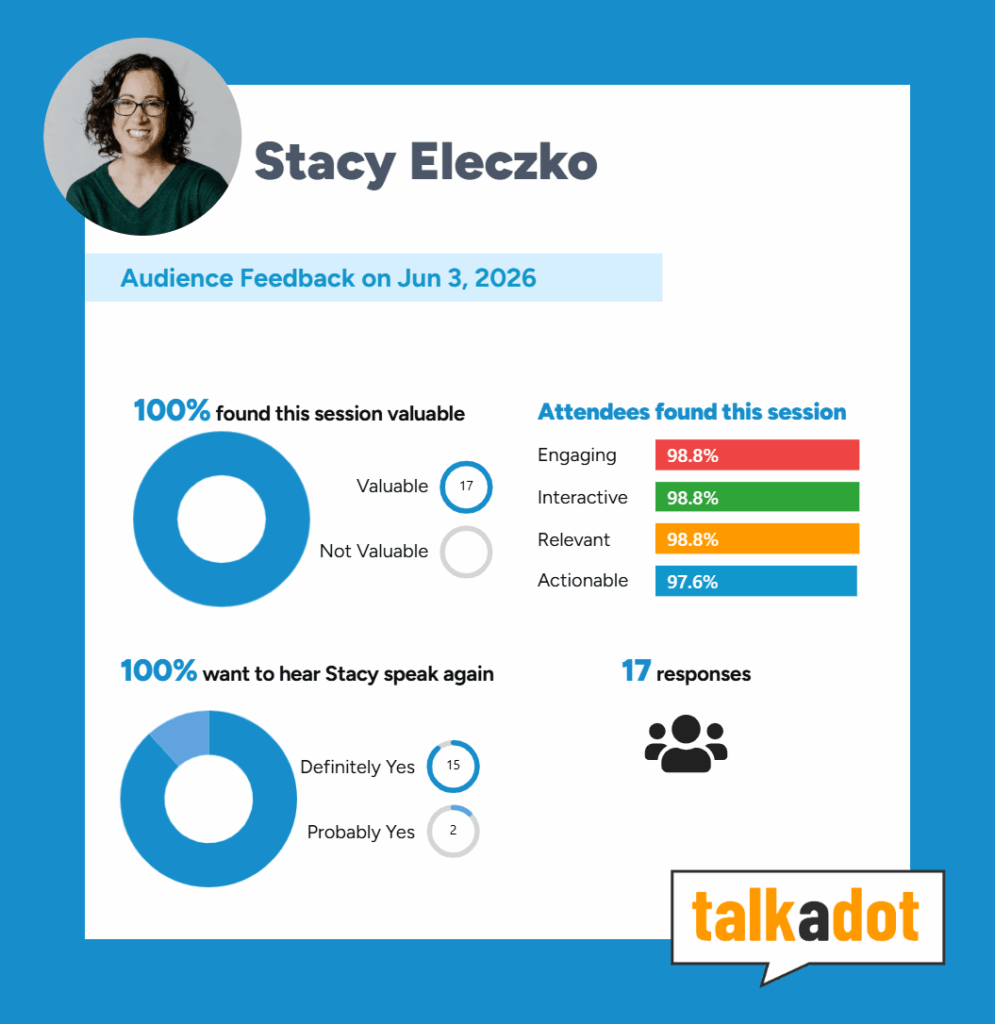
That’s 17 other people saying it, not me.
Data and statistics
Industry data tells your buyer “this isn’t just my opinion the research agrees.” If your work isn’t easily quantifiable, or you’ve only worked with a handful of clients and don’t feel like that’s impressive enough to mention, this is your solution.
Find a stat that applies to what you do and use it. Just make sure it’s recent, relevant, and from a reputable source, and always cite it. For example:
77% of B2B marketers say content marketing built trust and credibility with buyers–showing that clear, value-driven messaging is one of the fastest ways to earn confidence in a crowded market. (LeadForensics)
Credentials and certifications
This one depends entirely on your industry and your buyer.
Does your specific buyer use credentials as a filter? If yes, make sure they’re visible. If no, move on.
Press, podcasts, and media mentions
If you’ve been featured in a publication, quoted in an article, or invited onto a podcast, that’s social proof.
The trust mechanism here is third-party selection. Someone chose you, vetted you, decided you were worth their audience’s time, and put their name behind that decision. That’s meaningfully different from anything you say about yourself.
Not all appearances carry the same weight though. Think about which ones to leverage most and whether they’re relevant to the audience you’re trying to reach. I’ve been interviewed on podcasts that have also featured guests like Alex Cattoni, Seth Godin, and Jay Schwedelson.
(See… that name dropping was impressive, wasn’t it? 😉)
Most people mention these once and forget about them. Don’t.
Okay, this is starting to feel a little self-aggrandizing. 💅🏻 I promise my intention was to pull real-world and client examples throughout. But I’m writing this Monday afternoon with a 6am flight Tuesday, so you’re getting what I have easy access to. Bear with me.
Collaborations and partnerships
Remember Renee?
When she introduced me to that room, she didn’t just tell them what I do. She told them why she trusted me, that she’d worked with me, that she sent her own clients to me, and that she’d hire me herself.
That’s borrowed authority. And it’s one of the most powerful forms of social proof there is because you’re inheriting it from someone the room already trusts.
Out of the 9 people in that session, I walked away with one new client already underway, two proposals out, and multiple inquiries plus new newsletter subscribers.
I’ve done keynotes and workshops before. They’ve always been good lead generators, but not at this percentage. When I thought about what was different, it was that credibility and vouching piece. (Thanks, Renee.)
You don’t have to host workshops or speak from stage to borrow trust. A warm introduction in an email, a recommendation in a Slack community, a colleague who mentions your name before you walk into a room, that all holds the same weight. And you can be intentional about cultivating it.
Numbers and scale
This one is straightforward but only works when you actually have the numbers.
- How many clients have you worked with?
- How many projects completed?
- How many people are on your email list?
- How many years in business?
These are volume signals. They tell your buyer that other people have trusted you at scale.
If you’ve got them, use them. “I’ve worked with 40+ service businesses.” “This newsletter goes to 1,073 readers.” “Ten years in the industry.”
If you don’t have them yet? That’s okay. That’s exactly why we’ve covered everything else on this list. Use what you have.
Case studies
Think of case studies as testimonials on steroids.
A strong case shows the full journey: where the client started, what the problem was, what changed, and where they ended up. And because it tells a complete story, it can have testimonials, data, credentials, and results all embedded within it.
More than anything else on this list, a case study is proof that travels without you in the room. Someone can read it and see themselves in your client’s before, follow the journey, and arrive at the after and think: that’s what I want. No other form of social proof takes your buyer through that full arc.
And what do you know… I just happen to have a handy dandy Story-First Case Study Guide that walks you through exactly how to do this. 37 people have already grabbed it.
You’ve got the proof. Now what?
Before we get into where each type of proof belongs…
Not every buyer comes to you at the same stage. Someone close to a decision needs different proof than someone who just found you.
A buyer putting together a shortlist is more likely to be influenced by logos, press mentions, credentials, and numbers and scale. They answer the question: is this person worth paying attention to?
A buyer who’s ready to say yes and just needs confirmation is the one reading your case studies and testimonials. These answer a different question entirely: is this the right person for me?
Build your proof strategy with both in mind.
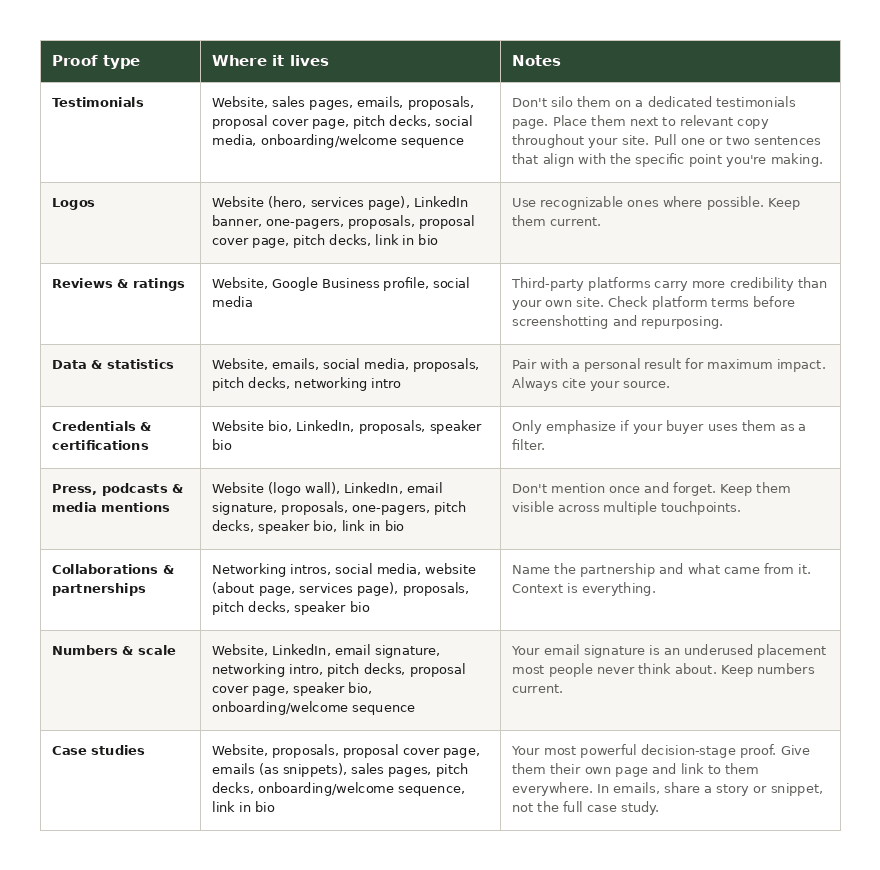
There’s no shortage of ways to build trust with the people you’re trying to reach. The key is being intentional about which proof you have and where it’s showing up.
Not sure which of these you’re missing or where your proof has gaps? That’s exactly the kind of thing we can work through together during a Clarity Call.
Any forms of social proof I missed? Or ones that work better for you than others? Hit reply. I’d love to hear and respond to every one.
Until next time,
Stacy

Heads up: May contain affiliate links. No cost to you, maybe a small kickback to me. I don’t recommend anything I don’t use myself.
When you’re ready…
1. Looking for the perfect place to use those customer insights? Earn trust with stories that sell. Grab my story-first case study guide.
2. Clarity call: Not sure what’s working? Get clarity on the problem that’s been spinning in your head. (One client called it “therapy for her brand.”)
3. Website audit: Get a fresh set of eyes on your website, sales page, or key asset. You’ll walk away with a prioritized roadmap of what to fix first and how to fix it.
4. 1:1 positioning, messaging, & copy projects Curious if it’s a good fit? Let’s chat. (Don’t worry. It’s just a conversation. No pressure or hard pitch.)
Blog cover photo by Kindel Media: https://www.pexels.com/photo/people-looking-at-smartphones-7770566/