
Most buyer personas don’t help you write better messaging
Buyer personas didn’t die. The lazy, surface-level, fill-in-the-template versions did.
Somewhere along the way, that turned into ‘we don’t need to understand our buyers that deeply anymore.’
Which turned into not really knowing who we’re talking to, why we’re getting overlooked, and not being able to figure out why our messaging feels off.
Here’s where things start to fall apart:
Piecing it together yourself
You’re pulling from what feels right, what you think people need to hear, and what everyone else in your industry seems to be saying.
Or even worse, what AI spits back after a vague prompt.
Without real customer insight, it’s incredibly easy to mistake assumptions for useful messaging.
When an agency hands you garbage
*steps onto soapbox*
Someone handed you a “messaging strategy” deck that looks great. And gives you absolutely nothing useful when it’s time to actually write.
I cannot tell you how many small businesses, especially consulting firms, have reached out after spending thousands on POV decks, messaging frameworks, and brand strategy docs… only for me to look at what they were given and think:

(I honestly wouldn’t be surprised if some of these decks are the same template with a few details swapped out.)
Because too many agencies prioritize speed and volume over depth.
And then you get handed something that still leaves you guessing when it’s time to write the website, sales page, LinkedIn content, or even explain what you do on a call.
When copywriting gets passed off as messaging strategy
Or it’s called “messaging strategy,” but it’s really just a quick questionnaire, a few generic prompts, and a swipe through your competitors’ websites.
Those are not the same thing.
There’s a difference between a strategist with copywriting chops and copy-led messaging work that never gets beneath the surface.
Whether it starts with DIY guesswork, a garbage agency deck, or copywriting passed off as strategy, the result is the same.
Your messaging blends in, sales cycles stay long, and discovery calls turn into education sessions.
👋🏻 Welcome to issue 91! Did someone send you? Join my other smart subscribers here.
The two mistakes I see over and over
Mistake one: you’re still building messaging around some version of CEO Suzie.
She’s 42, drinks oat milk lattes, and shops at Target.
Somehow this is supposed to help you figure out what to say on your website or how to introduce yourself at networking events.
If only it were that easy!
Mistake two: you heard that buyer personas, client avatars, and ICPs (or whatever you want to call them) were outdated and threw the whole thing out.
That’s a mistake too.
The worksheet died. The work didn’t.
You still need a research-backed understanding of who you’re speaking to.
To be clear, this doesn’t get solved with just a better buyer profile, but it’s a pretty damn good place to start.
What replaced the old-school persona
Instead of inventing a fictional person and guessing what keeps them up at night, we can pull from what real buyers are already telling us.
We can build from evidence, not imagination.
- What made them start looking for support now?
- What have they already tried?
- What are they afraid won’t work?
- What’s the real progress they’re trying to make?
This is usually the part nobody actually digs into.
And then six months later they’re wondering why growth still feels harder than it should and the messaging still sounds like everyone else’s.
What this actually looks like
On paper, Joe Rogan and Brené Brown look identical, but you would never market to them the same way.
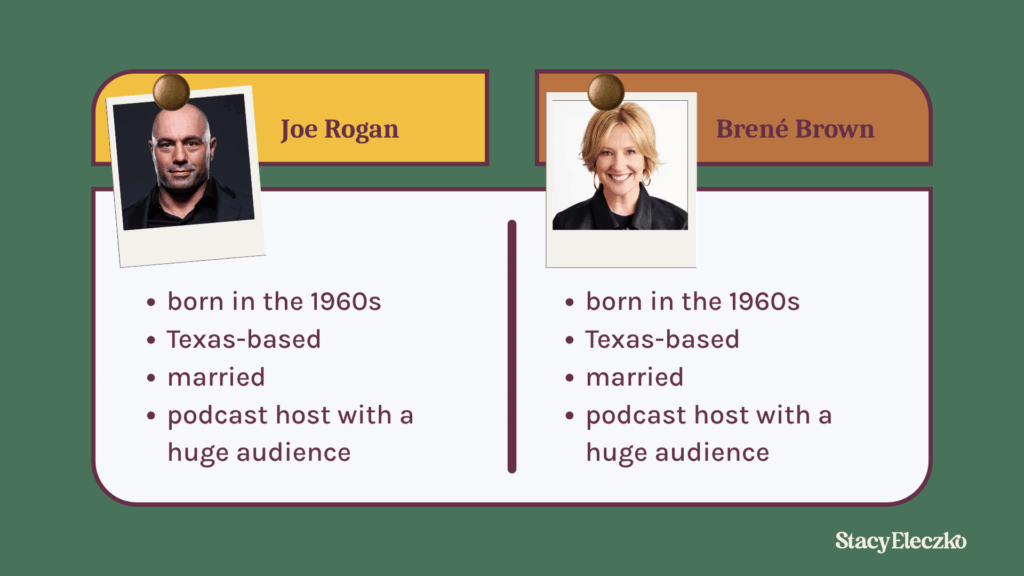
Now let’s bring that into your world.
Let’s say you’ve got your eye on two CEOs you’d love to work with. On paper, they look exactly like the persona you’ve been told to build:
- 42
- runs a consulting firm
- multiple six figures in revenue
- ready to invest in a website rewrite
Underneath that is a completely different reality.
One CEO:
She’s been burned before. She’s worked with an agency that handed her a pretty messaging deck that didn’t actually help her team say anything clearer. She’s skeptical and trying not to waste money again.
The other:
She’s grown almost entirely through referrals. She’s never really had to think about messaging before, and now she’s realizing it’s the thing holding the business back. She’s not skeptical. She’s trying to figure out how to translate what they do into something that scales.
Those are two completely different conversations.
(Also… which is more helpful here? “CEO Suzie, 42, shops at Target” or this?)
The first CEO needs to hear:
- why your process goes deeper than what she’s experienced before
- how you avoid surface-level strategy
- what makes this worth trusting again
The second needs to hear:
- how you’ll help her clarify what she already knows
- how this turns her expertise into something visible and scalable
- what this unlocks for her next stage of growth
If you try to speak to both of them, it won’t resonate with either.
This is what that actually changes in the message
Most businesses try to write one message that covers both. It usually sounds something like:
“We help you clarify your messaging so you can stand out, attract the right clients, and grow your business with confidence.”
It could apply to anyone. While it sounds fine, it doesn’t make anyone feel seen.
Even if people are both hiring for the same thing, what they need to hear is completely different.
For the CEO who’s been burned before:
““If you’ve already invested in messaging and walked away with a deck that looked impressive but didn’t give you a single usable line for your website, you’ve already seen where this falls apart.”
For the CEO who’s grown through referrals:
“If your business has grown through referrals but you’re still relying on word-of-mouth to explain what you do, this is where things start to bottleneck.”
You can’t say it all one message
Because both of those CEOs could be a perfect fit for your work, the instinct is to try to speak to both of them at the same time.
You either end up with something so broad it doesn’t land with either of them or something that kind of hints at both but doesn’t fully click for either one.
Where each message actually goes
Instead, you have to be more intentional about where and how each message shows up.
On a website:
Different sections do different jobs. One section speaks to the person who’s been burned while another speaks to the person who’s outgrown referrals.
In your content:
This is even simpler.
Pick one and write the post, the email, or the sales page for that version of the buyer. Over time, you make sure you’ve covered both.
In discovery calls/sales conversations
With the CEO who’s been burned before, I wouldn’t lead with what I do. I’d help her see why what she’s already tried didn’t work, and what would need to be different this time for it to actually stick.
With the CEO who’s grown through referrals, I wouldn’t unpack past frustration.
I’d help her see what’s changing in her business and why what got her here won’t keep working at the next stage.
The only thing that matters?
Each of them needs to understand why this matters to them.
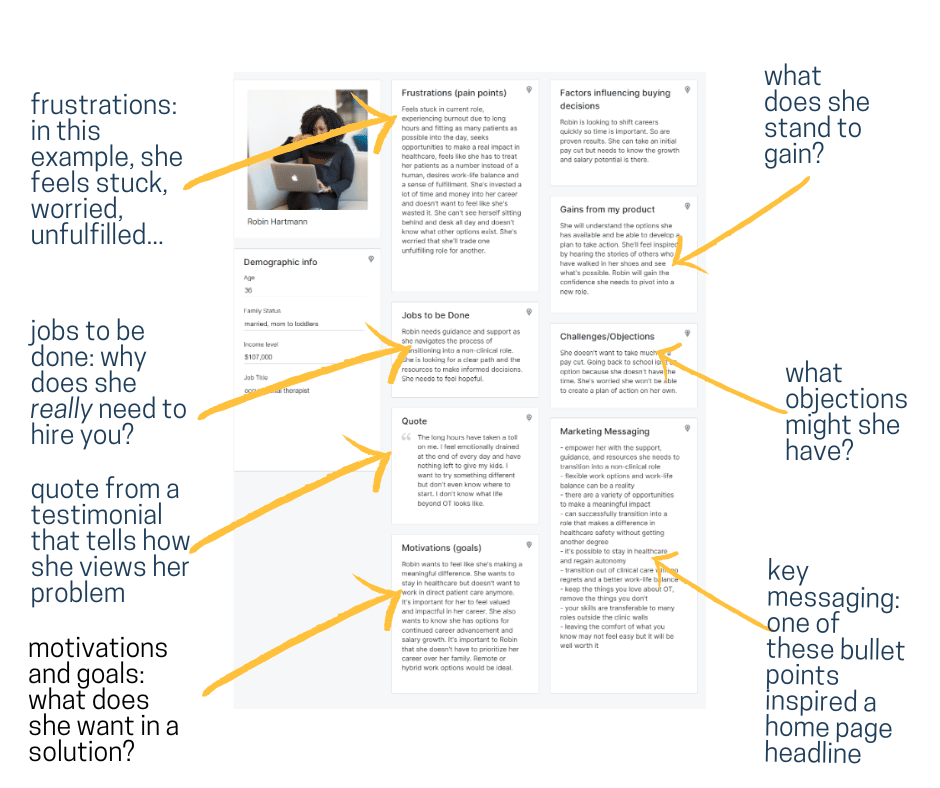
What should actually be in a useful buyer persona?
This is how you build a client profile you can actually use to inform your marketing messaging.
Start with what actually drives decisions.
Forget the fluffy demographics. A useful buyer persona should help you answer questions like:
- What made them start looking for support now?
- What do they believe the problem is?
- What have they already tried?
- What objections or hesitations keep coming up?
- What would have to feel true before they say yes?
- What does success actually look like to them?
This is the kind of work that tells you exactly what they need to hear.
Where strategy starts influencing the message
A strong buyer profile helps shape:
- what shows up on the homepage
- what gets emphasized on the sales page
- what objections need to be addressed in content
- what needs to happen on discovery calls
- what to say when someone is making a decision about whether to buy
This is where the work stops living in a deck and starts showing up in actual decision making.
What they’re really hiring you for
This is also where surface-level messaging usually stops too soon.
There’s the functional jobs-to-be-done. For example, my clients need:
- A website rewrite
- A messaging deck to hand off to their PR agency
- A sales page
But that’s rarely the whole job.
There’s the social jobs-to-be-done.
How do they need to be perceived by others?
And the emotional jobs-to-be-done.
- What are they afraid of?
- What pressure are they under?
- What are they really hoping this solves?
What someone says they need and what they actually need to hear before they buy are often two very different things.
What they need to hear is why this matters now, what happens if they stay where they are, and why your approach is the right fit for where they need to go next.
Before you update another marketing asset
Before you rewrite your homepage, brief a copywriter, or post another LinkedIn thought piece, stop and ask:
Do I actually know what had to feel true for someone to buy from me?
Not what I think they care about or what sounds smart, but what they’ve actually shown me through their language and decisions.
The businesses that get remembered aren’t writing to everyone. They know exactly who they’re talking to, what that person has already tried, and what needs to be true before they’ll trust someone new.
Put this into practice
Pick three recent clients. What did they say they needed? What did they actually need to hear before they said yes?
Until next time,

When you’re ready…
1. Looking for the perfect place to use those customer insights? Earn trust with stories that sell. Grab mystory-first case study guide.
2.Clarity call: Not sure what’s working? Get clarity on the problem that’s been spinning in your head. (One client called it “therapy for her brand.”)
3.Copy audit: Get a fresh set of eyes on your website, sales page, or key asset. You’ll walk away with a prioritized roadmap of what to fix first and how to fix it.
4.1:1 positioning, messaging, & copy projects Curious if it’s a good fit? Let’s chat. (Don’t worry. It’s just a conversation. No pressure or hard pitch.)