
Over the last two weeks, we’ve been deep in Voice of Customer (VoC).
We’ve talked about where it lives, how to collect it, and why the messy, pre-decision language matters more than the polished testimonial someone gives you after they’re already thrilled.
We’ve talked about filtering for your best-fit buyers instead of grabbing quotes from anyone who’s ever said something nice.
And we’ve talked about interpretation—how the real work isn’t in what people said, but in what had to feel true for them to say yes.
That’s the strategic layer.
Okay, but what do you actually do with all that VoC data?
But eventually, strategy has to turn into something tangible. So the real question is: once you’ve collected and interpreted all of this language, what do you actually do with it?
Because having folders full of transcripts, screenshots, surveys, and sales notes doesn’t automatically make your marketing stronger. You can gather incredible insights and still end up with copy that sounds like everyone else if you skip the translation step.
Today, we move from analysis into application.
When I say copy, I’m talking about the parts of your marketing that are designed to move someone, the words that turn “I think so” into “This makes sense”.
- Headlines that grab attention and keep people on the page
- Calls-to-action that feels aligned with where they are instead of prematurely pushing them somewhere they’re not ready to go
- Sections that answer the question they didn’t know how to articulate yet
And this is why deeply knowing your buyer isn’t optional. They have to see themselves in your copy. This is all about getting the right message to the right person at the right time.
They have to feel that you understand what they’re navigating, what they’ve already tried, what feels risky, and what would need to feel safe before they move forward.
Voice of Customer language is one of the most effective ways to create that recognition because it mirrors the internal dialogue that’s already happening while someone is weighing their options.
Stong positioning. Weak messaging.
Yes, this example is B2C. That’s irrelevant.
The mechanics of decision-making don’t change just because the buyer is an individual instead of a leadership team. Tension is tension, and pattern recognition is still what it’s all about.
An acupuncture clinic hired me because they were positioning themselves as “not your traditional acupuncture.”
The positioning was strong, but the messaging? Not so much. When someone landed on the website, they didn’t immediately understand what that meant or why it mattered.
“Not traditional” could mean a lot of things: more holistic, more clinical, more modern, more aggressive. More… what, exactly?
So we did what I always do. We looked at competitors, clarified what actually differentiated them, and then dug into Voice of Customer.
Yes, I’ve told you that pre-purchase language is more powerful. That’s still true. But in this case, the testimonial and review patterns confirmed what other research was pointing toward. (I also already had the screenshots ready. 🤷🏻♀️)
Over and over again, people said some version of the same thing:

The clinic could fix problems that all other solutions failed. They would have never led with that. And when I suggested they did, there was hesitation over whether it was too bold.
But the pattern was way too clear to ignore. People weren’t hiring them because they were “not traditional.” They were hiring them because nothing else had worked.
So I translated that tension into a line that did the heavy lifting and ended up on a shirt!
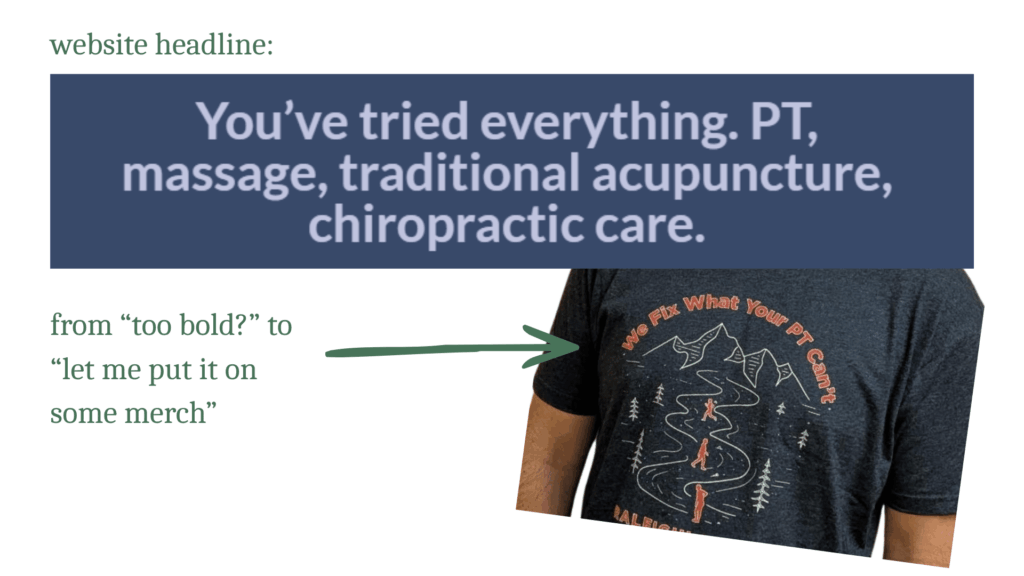
That’s not clever copy. (Okay, maybe it’s a little clever.) It’s interpreted Voice of Customer language that works because it’s also incredibly clear.
It immediately answers the question: “Why you?”
It names the failed alternatives, validates the frustration, and it gives someone the logic to justify what already feels true—that they’re ready to try something different.
Once that language went live, something interesting (but not unexpected) happened.
Referrals started coming in already framed that way. “My PT didn’t help, but my friend said you fixed their pain even when their PT couldn’t.” Website leads increased without any additional traffic. Even some PTs referred patients.
When your copy reflects the story people are already telling themselves, it shortens the distance between interest and action.
Turning client interviews into strategic messaging
This next example is from Strelo Group, an organizational change consultancy. (Quick shout out to my partner on this project, Renee Frojo.)
In this case, I conducted in-depth client interviews, my absolute favorite way to collect relevant insights.
After these interviews, I looked for the Jobs to Be Done (JTBD) and for the patterns and trends that existed across them, the throughline.
Here’s one insight we uncovered that informed their messaging (what they say) and later their copy (how they say it).
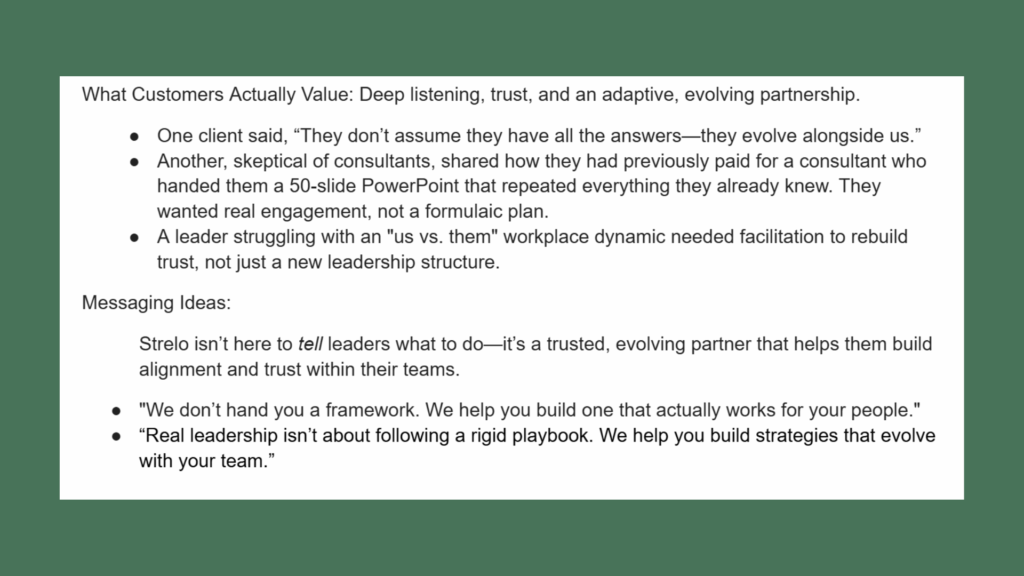
On the surface, it was predictable. Clients talked about strategy, alignment, leadership, communication, and sustainable change.
If we had stopped there, the messaging would have sounded like every other firm in their space. Trust me, I reviewed a lot of websites during the market research.
But when we started clustering the language, something else kept showing up.
They weren’t frustrated because they lacked plans, but because plans didn’t stick. That’s a very different job and tension to address.
The tension was this: leaders didn’t want another deck. They wanted change people actually believed in.
We centered messaging around ownership. We led with co-creation instead of deliverables. Instead of promising transformation as an outcome, we positioned Strelo as a partner who evolves alongside the organization.
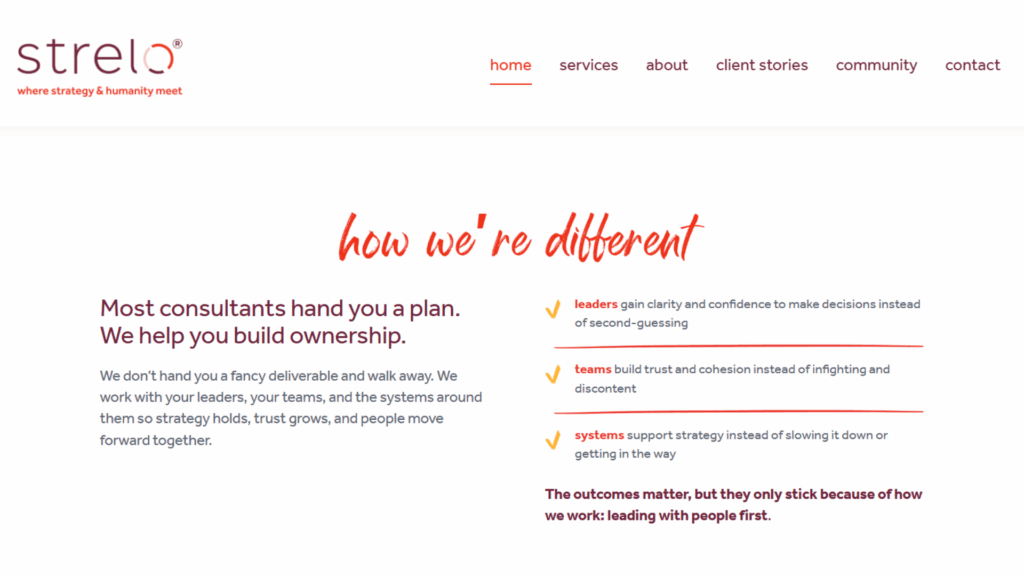
Now, when prospective clients land on their website, their hesitations are immediately addressed.
That’s not accidental phrasing. It was a strategic decision based on what clients were reacting to and what they were trying to protect.
If we had simply “tightened the messaging,” we would have missed that entirely. That’s the difference between quoting Voice of Customer and interpreting it.
Voice of customer in content and conversion strategy
I’ve literally never had an easier time of collecting VoC language than when we launched Content Circle.
We were consistently seeing people talk about how hard it felt to create LinkedIn content. They didn’t know how to translate what they knew into posts that actually connected and drove business. They had:
- tabs open
- drafts sitting unfinished
- docs full of ideas
Every LinkedIn post, and launch asset, we wrote relied heavily on that language.
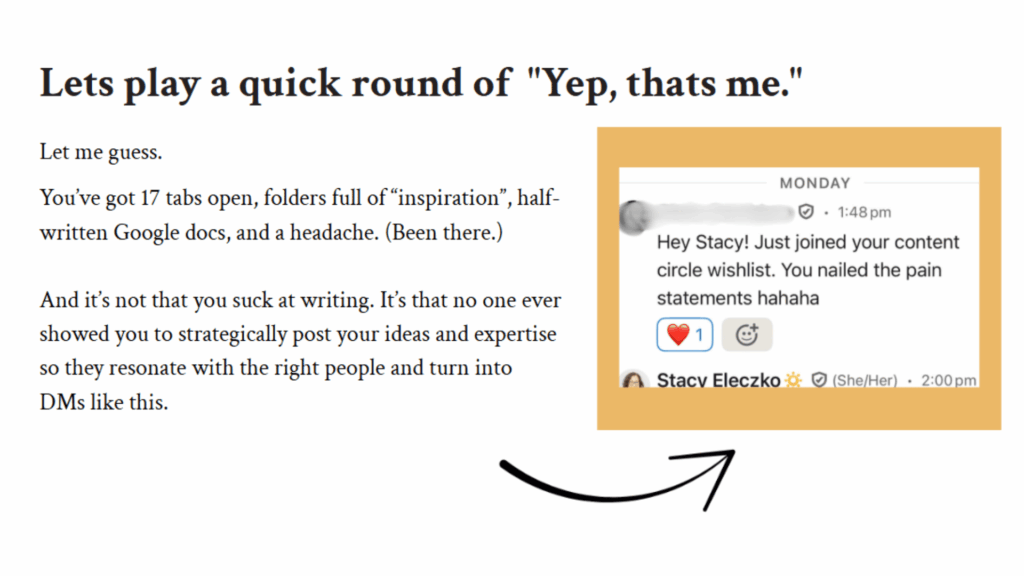
That DM came from someone who saw one of those posts. He joined the waitlist, became a founding member, and has since renewed and is still inside the membership.
(And yes, I realize this is another B2C example. It’s also a perfect excuse for a shameless Content Circle plug. Two things can be true.)
Now, before you think this is how it always works—post once, get a DM, done—it’s sadly not often the case.
People need more than one touchpoint. In fact, depending on the research you look at, it can take anywhere from 8 to 50. And the higher ticket your offer is, the longer that sales cycle tends to be.
It is not typical that you post and someone immediately bites, but it absolutely can happen. And when it does, the part that resonated is almost never random.
Every time I’ve gotten an inbound lead for my 1:1 services and someone has told me what specifically stood out, it was something I pulled directly from Voice of Customer language.
That’s not coincidence; it’s what happens when your messaging is built from what buyers are already thinking.
The missing step between VoC and messaging + copy
The examples I shared work because the language didn’t stop at collection.
People have been told to use Voice of Customer language: use their words, mirror their pain points… but very few people are shown what that actually means in practice.
So they collect it, highlight a few strong quotes, and start drafting.
It looks strategic. (It isn’t.)
Because the quote itself isn’t the strategy. You have to find the patterns and the decision logic underneath.
You don’t need to quote the insights verbatim.
For example, clients might refer to the same problem in different ways: spinning their wheels, stuck in a loop, repeating the same mistakes. You can absolutely use these phrases, but you can also frame it as: circling the same ideas or defaulting to what feels safe or mistaking activity for progress. Depending on the context, these will still resonate.
Voice of Customer gives you raw material. → Interpretation gives you direction. → Translation turns it into an asset.
The difference between messaging that sounds fine and messaging that actually moves people usually comes down to the thinking that happens before the writing. Without that layer, you end up endlessly tweaking words without changing outcomes.
If you want help making sure the language you’ve collected is actually being translated into something strategic, let’s talk.
Until next time,

Stacy
When you’re ready, here’s how I help:
1. Copy audit: Get a fresh set of eyes on your website, sales page, or key asset. You’ll walk away with a prioritized roadmap of what to fix first and exactly how to fix it. *This offer is getting a complete overhaul. Book now if you want to grab it at this price.
2. Clarity call: Not sure what’s working, or what’s not? Get clarity on the problem that’s been spinning in your head. (One client called it “therapy for her brand.”)
3. 1:1 positioning, messaging, & copy projects Curious whether it’s a good fit? Let’s chat. (Don’t worry. It’s just a conversation. No pressure or hard pitch.)