
When people talk about positioning, they usually focus on two things: who they are as a brand and who their audience is.
Yes, both matter, but neither is enough. Positioning only works when three things are understood together:
- who you are and what you stand for
- what your audience needs to hear in order to choose you
- what already exists in the market they’re comparing you against
That third piece is the one most B2B brands rush past, or skip entirely.
And when they do, they don’t just miss opportunities to differentiate. They actively make positioning harder for themselves.
There are two massive mistakes I see B2B brands make when it comes to competitor research, and both quietly undermine positioning in ways most teams don’t realize.
Mistake #1: Not doing competitor research at all
This is the one I see most often, and it usually shows up in a few familiar ways.
“We don’t really have competitors.”
“We already know what sets us apart.”
“We don’t want to sound like our competitors, so we don’t need to look at what they’re saying.”
All of those sound reasonable. None of them hold up.
“We don’t really have competitors” (and why that’s wrong)
Your buyers rarely evaluate you in isolation. They’re comparing you to alternatives, whether you acknowledge them or not. Even if they don’t call themselves what you call yourself, and yes, even if you don’t like being grouped with them.
They’re scanning websites, skimming messaging, listening for familiar language, and trying to understand where you fit. If you don’t know what else is in that mental comparison set, you can’t clearly communicate why you’re the right choice.
They’re comparing other:
- providers
- approaches
- ways to solve the problem
Sometimes that option is doing nothing at all. But it’s still a comparison being made.
Here’s how this might show up.
What buyers are actually comparing you to
Say you sell a SaaS project management platform.
As a buyer, they’re not just comparing you to another project management tool.
Provider: They might be looking at a well-known enterprise platform because it feels safer, even if it’s bloated and expensive. Or a smaller, newer tool that’s cheaper and simpler, even if it’s missing features you have.
Approach: They could decide they don’t need “project management software” at all and choose a communication-first approach instead, relying on Slack, email, and shared docs to keep work moving.
Way to solve the problem: Or they stick with spreadsheets and homegrown systems because switching tools feels disruptive, risky, or like more work than it’s worth right now.
From your perspective, these might not feel like direct competitors. From the buyer’s perspective, they absolutely are.
And if you haven’t done the research to understand which of these options your buyer is actually weighing, you’re guessing about what needs to be clearer, easier, or more compelling.
Why “we already know what makes us different” isn’t enough
The second thing I hear is, “We already know what makes us different.”
And you might. But knowing what you believe makes you different isn’t the same as knowing whether it actually is different in the market.
I worked with a CEO of an executive coaching firm who was confident in what set their company apart. They didn’t see a need for competitor research. When I did a quick scan of other firms their ideal clients were likely considering, I found three of them making very similar claims.
As a prospective buyer, they all seemed to be offering the same solution in the same way.
This is the risk of skipping competitor research. You don’t end up copying; you end up converging. (This is also how you end up competing on price. 😓)
Understanding the competitive landscape protects your differentiation
The third argument usually goes like this: “We don’t really have competitors”.
If you don’t know what your competitors are saying, and how they’re saying it, you have no way of knowing whether you’re actually differentiating or just circling the same ideas with slightly different words.
Competitor research isn’t about borrowing language. It’s about understanding the landscape so you can make deliberate choices.
That includes looking beyond offers and pricing to things like:
- what problems they lead with
- the outcomes they emphasize
- who they’re clearly speaking to
- how they sound when they speak
Are they polished and corporate? Casual and conversational? Aggressive and urgency-driven? Safe, vague, and reassuring?
When everyone in a space sounds the same, nothing stands out. And if you haven’t mapped that landscape, you can’t intentionally position yourself outside of it.
Skipping competitor research doesn’t protect your originality. It weakens it.
Mistake #2: Looking at the wrong competitors
Even when brands do competitor research, they often end up looking in the wrong places.
This usually starts with a well-intentioned shortcut: “We know who our competitors are because our clients told us who they were working with before.”
The problem is that comparison data is almost always skewed.
Where direct competitor research goes wrong
You’re hearing about competitors at the moment someone is leaving them. Which means:
- the service wasn’t meeting their needs anymore
- the business had evolved beyond what that provider was built to support
- or the relationship had simply run its course
In other words, you’re often comparing yourself to someone your buyer has already outgrown. That’s not the same thing as understanding who you’re truly competing with at the moment a decision is made.
Another issue is that many of these comparisons come from a different level of the market altogether.
Your buyers may be referencing:
- lower-priced providers
- less experienced consultants or teams
- tools or services they chose earlier in their business journey
And if you anchor your positioning to those comparisons, you end up defining yourself in opposition to the wrong alternatives.
For example, say you do organizational change consulting.
When clients tell you who they worked with before, it’s often:
- a solo consultant they hired early on because it was affordable and familiar
- an internal HR lead who was asked to “own change management” alongside everything else
- a short-term workshop or training that checked a box but didn’t actually shift behavior
By the time they’re talking to you, their needs have changed. The organization is larger, the stakes are higher, and the problems are more complex.
But if you treat those past providers as your primary competitors, you’re anchoring your positioning to a lower bar.
You start explaining why you’re more strategic and how your work goes deeper.
That may all be true, but it’s unnecessary if you were positioning against the right alternatives.
The more relevant comparison is often happening elsewhere.
And there’s another layer to this mistake that shows up more subtly.
When you only look at competitors your clients left, you miss the ones they seriously considered but didn’t talk to you about: the short list of alternatives that felt close enough to be tempting.
Those are often the competitors that matter most.
And yes, having aspirational brands you admire or want to emulate is great. But those aren’t competitors, and treating them like they are won’t help your buyer choose you.
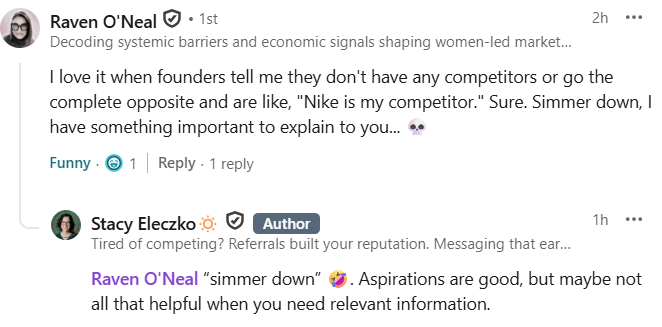
If your competitor research doesn’t reflect who your buyer is actually choosing between right now, your positioning will always be slightly off.
And in positioning, “slightly off” is enough to cost you clarity, confidence, and conversions.
But even this assumes your buyer is choosing between providers. Often, they’re not. They’re choosing between you and an entirely different way of dealing with the problem.
The 3 types of competitors most brands overlook
Even when brands identify the right direct competitors, they often stop too soon.
There are alternatives that don’t look like competition on the surface, but absolutely function like it in the buyer’s mind. These are the competitors most brands overlook.
Indirect competitor #1: Inaction
Inaction is the decision to do nothing.
It’s not because the problem doesn’t exist, but because addressing it feels uncomfortable, overwhelming, or risky.
From the buyer’s perspective, inaction is often framed as patience or prudence. From a positioning perspective, it’s a competing choice.
If your positioning doesn’t clearly articulate what it costs to wait, inaction wins by default because it feels safer than making the wrong move.
Indirect competitor #2: Status quo
Status quo is not the same as inaction.
This is the decision to stick with what’s familiar:
- the same provider they’re no longer thrilled with
- the same internal workaround
- the same process that’s “working well enough”
You’re not just competing against other options here. You’re competing against comfort.
If your positioning doesn’t make it clear why change is worth the disruption, the status quo will almost always win. Even when it’s inefficient or frustrating, and everyone knows it’s not the best solution.
Indirect competitor #3: AI
Whether brands want to admit it or not, everyone is competing with AI right now.
Not because AI is better at the work, but because it’s increasingly the first place buyers turn when they’re trying to make sense of a problem. Before they talk to a human, they open ChatGPT, Claude, or Perplexity to:
- define what the problem even is
- explore possible solutions
- get a sense of what “good” might look like
This shows up differently depending on the industry.
A travel agency isn’t just competing with other agencies. They’re competing with someone opening ChatGPT and typing, “Plan me a 10-day trip to Italy with great food, boutique hotels, and minimal travel time.”
An EOS implementation company isn’t just competing with other implementers. They’re competing with leadership teams asking AI to summarize EOS, outline meeting structures, and generate accountability tools they can “try internally first.”
In both cases, AI becomes a low-friction alternative. It’s the thing buyers experiment with before they decide whether they need outside help.
And this is exactly how it shows up in my work.
By the time someone talks to me, many have already used AI to “do” their positioning or messaging. They’ve asked it to:
- write mission, vision, and values
- summarize their ideal client
- analyze competitors
- clarify differentiators
- generate messaging they plan to tweak
What I see when those same people come to me is consistent.
They struggle to clearly articulate what actually makes them different, where they fit in the market, or why a buyer should choose them over another credible option.
This is because AI helped them confirm what they already believed instead of challenging it.
AI is designed to be agreeable. It doesn’t push back. It doesn’t say, “This isn’t distinct,” or, “Five other brands are making the same claim.” It gives you something that sounds plausible and lets you move on.
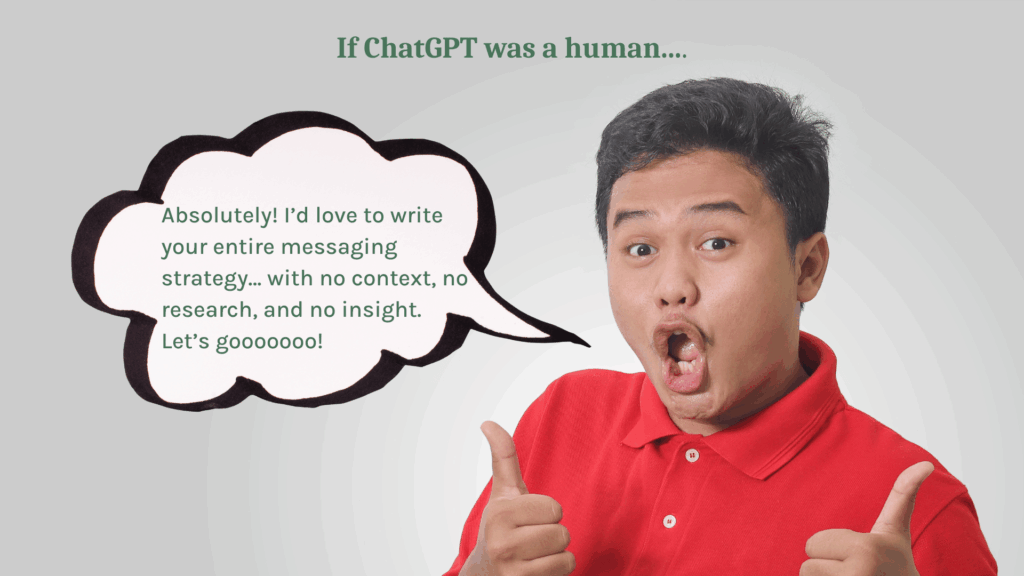
That’s where AI becomes a competitor for me.
It removes the friction that real positioning work requires. The discomfort of realizing your message isn’t as clear or differentiated as you thought. The hard decisions about who you’re actually for, what you’re willing to say, and what you’re willing to leave behind.
AI can help with execution, but it can’t replace discernment. I don’t compete with AI on speed or output. I compete on judgment. On:
- seeing what clients are too close to see
- understanding the competitive landscape, not just summarizing it
- identifying what’s actually distinct, not just what sounds good
If your positioning relies on AI to tell you who you are, your messaging will always struggle to explain why someone should choose you. And that’s true whether you’re selling strategy, software, services, or expertise.
How to identify competitors that actually matter
Once you understand that competition isn’t just “companies that look like you,” the next question becomes: How do you actually identify the right competitors to study?
Start by separating them into two buckets: direct and indirect.
Finding your direct competitors
Direct competitors are the options your buyer could reasonably choose instead of you right now. Ask yourself:
- Who shows up when a buyer searches for solutions like mine?
- Who feels close enough in scope, price, or promise to be a real alternative?
- Who would make a buyer pause and think, “Should I talk to them too?”
- Do a quick search using your job title/description. Look at the results but also look at “people also ask”.
Ask current or past customers. What other options did they consider? This works even better if you ask during discovery calls, when they’re actually in decision mode.
Identifying your indirect competitors
Indirect competitors are the alternatives that change the decision entirely. Ask yourself:
- What happens if my buyer decides to do nothing?
- What does “good enough” look like for them right now?
- What internal workaround, existing provider, or AI shortcut might feel easier than choosing me?
- Do a search asking for alternatives to your job title/description. (This is a great use of AI in this work.)
Do you know people who fit your target market? Ask them: If you were looking for [your service/product], what other services/products would you research?
The goal of competitor research isn’t to track everyone. It’s to understand the decision set your buyer is actually navigating.
If you don’t know what they’re choosing between, you can’t position yourself as the obvious choice.
When to revisit your competitor research
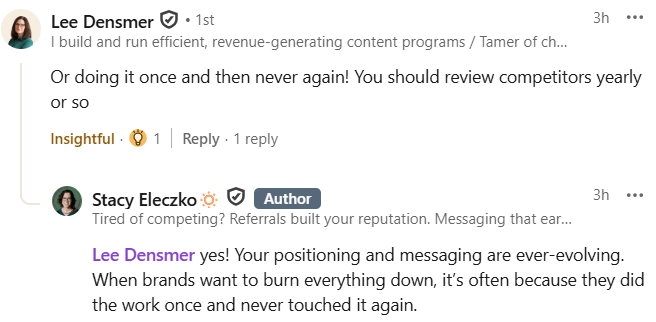
It’s also important to note competitor research isn’t a one-and-done exercise. As a key part of your positioning and messaging, it evolves as your business evolves.
- Your audience shifts
- Your offers change
- Your pricing changes
And while this is happening for you, it’s happening for your competitors too.
If you’re not revisiting these inputs regularly, you end up with messaging that feels increasingly disconnected from where your business actually is. That’s usually the moment when everything starts to feel messy and outdated at once.
👉🏻 Not sure how to identify your real competitors, or what to do once you do? This is exactly the kind of thing I help clients work through during a Clarity Call.
More on how buyers actually decide
🎙️Justin Vajko invited me on his podcast to talk about a mistake I see all the time, especially in referral-grown businesses. Listen in to find out where your messaging might be breaking down.
🎙️Andy Milligan hosted me on Marketing by Design. We chatted about my LinkedIn strategy, empathy in messaging, and 6 questions to ask for killer testimonials. Tune in here.
Until next time,

Stacy