
I planned to dive deeper into competitor analysis this week. It’s an important part of positioning, and one that rarely gets the attention it deserves.
But a single comment from Bryan Yates on LinkedIn changed the direction of this entire issue.
I mentioned that clients sometimes push back on competitor analysis. Bryan made an observation I couldn’t stop thinking about: sometimes people aren’t resisting the work; but what the work might reveal.
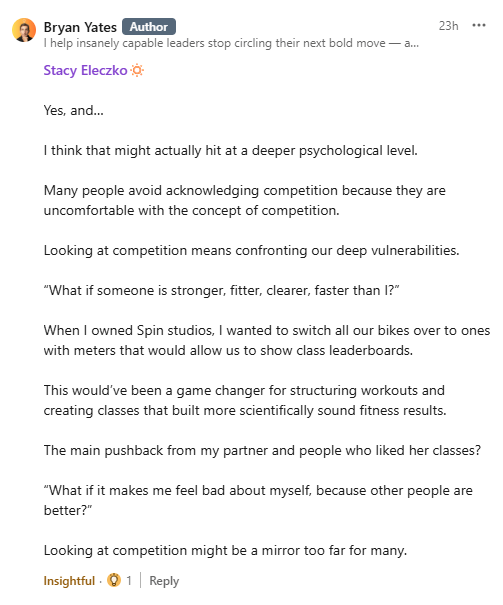
Once I sat with it, what I really needed to write about became obvious.
Some objections aren’t really objections. They’re emotional signals, and if you miss them, your messaging addresses the wrong thing.
Last week, I shared why clarity alone isn’t enough and why positioning hinges on:
- who you are
- who you’re for
- who you’re up against.
I planned to dig into that third piece today.
Bryan’s comment reminded me that resistance to competitor analysis is often emotional–fear of the comparison and what it might reveal or confirm. That’s exactly where positioning (and later, messaging ) starts to get tangled.
When people hesitate, it’s rarely the whole story. If you stay at the surface level, you miss the insight that actually matters: the reason underneath the reason.
👋🏻 Welcome to issue #77! Each week I share insights that turn why they buy into how you market (and sell). Not subscribed yet? Clickhere.
What people say (and what they really mean)
When someone raises a concern or hesitates during a conversation, it’s natural to assume the reason they give is the real reason.
But the stated objection is almost never the whole story.
This isn’t dishonesty. Most of us don’t fully understand our own hesitations.
Think about the last time you stalled. You probably gave a practical reason like calendar, budget, or priorities, while the part that mattered lived somewhere deeper.
Your clients are doing the same thing.
💬 What they say: “We want to wait a bit.”
💡 What they’re feeling: I’m overwhelmed and don’t have the capacity to think clearly right now.
💬What they say: “We need to tighten a few things up internally first.”
💡What they’re feeling: I’m not ready, and I’m worried you’ll see the messy parts I’ve been ignoring.
💬What they say: “I need to check with leadership.”
💡What they’re feeling: Something in me doesn’t feel settled yet, and I don’t know how to explain it.
And this is where conversations get confusing. Not because the other person is withholding clarity, but because the hesitation they feel is emotional, while the explanation they give is practical.
If we only respond to the practical words, we solve the wrong problem. But when we listen for the unspoken layer, the part they’re still figuring out, everything becomes clearer.
This difference is where your message and your sales process either connect or skim the surface.
The easiest objection to grab
If there’s one objection every business hears, it’s pricing. And pricing is almost never about pricing.
People reach for money because it’s the easiest explanation. You can say “This is more than I planned to spend” without revealing anything personal.
But underneath that practical explanation is almost always an emotional hesitation they may not even recognize.
❌ “It’s more than we budgeted for.”
Translation: “I can’t afford another decision that makes me look wrong.”
❌ “We should revisit this next quarter.”
Translation: “I don’t feel ready, and I don’t want to admit that.”
❌ “Can you send more details?”
Translation: “I need space to figure out why I suddenly feel nervous.”
Pricing objections remind us of something easy to forget: the real decision happens long before the explanation someone gives you.
The 80/20 rule
You’ve probably heard the idea that buying decisions are “80% emotion and 20% logic.” It’s a core principle in buyer psychology: Emotional Reasoning.
People feel their way into a decision long before they can explain it. Emotion fires first; logic simply narrates whatever they’ve already decided.
You’ve done this yourself. You’ve felt drawn to something you couldn’t articulate or felt resistance you couldn’t rationalize.
Emotion drives the decision while logic justifies it.
And this is why deeply understanding your audience shifts everything.
Why people finally say yes 💍
The goal for your messaging is to speak to what hasn’t named yet: the tension they feel, the pressure they’re carrying, the uncertainty they don’t want to repeat…
When you do that, people stop scanning for red flags. They feel understood, and as a result, there’s less resistance.
And in that space, they can evaluate the decision without all the internal noise.

This is why my clients often see shorter sales cycles and easier discovery calls even before their messaging is finalized.
It’s because they’ve deepened their understanding of their audiences, and what they say finally aligns with how people actually make decisions.
That’s the real meaning behind the 80/20 rule. It’s not about “using more emotion.” It’s about understanding the emotion that’s already driving the conversation.
To understand your audience more deeply, start with the objection you hear most. The one that’s become so familiar you barely register it anymore.
Take that objection, word for word, and write it down.
Now here’s where this gets interesting.
Find out what’s really going on
Here’s how you can explore the layer beneath the words.
After you write down the objection as it’s usually said, ask yourself:
“If I set their exact words aside for a moment… what might they be trying to communicate through this?”
Here’s what it looks like in practice:
A consulting firm is talking to a potential client who says: “We really prefer to keep this work in-house.”
Instead of taking that at face value, try this:
1. So what? What might that actually mean?
▶️ They think an internal hire will be cheaper or easier.
2. So what? Why does that feel important?
▶️ They’ve already spent money trying to solve this, and they don’t want to feel like they made the wrong call.
3. So what? What’s underneath that?
▶️ Admitting they need external help feels like admitting they should’ve invested in strategy earlier.
4. So what? Why does that discomfort matter here?
▶️ Because outside support feels exposing. It surfaces gaps they’ve been avoiding or didn’t have language for.
5. So what? What’s the real hesitation at the bottom?
▶️ It’s not actually about in-house vs. external. It’s self-trust, the fear of choosing wrong again or being judged for past decisions.
And none of that shows up in the words: “We’d rather keep this in-house.”
This exercise helps you understand what your buyer is really trying to protect, avoid, or make sense of long before they ever put words to it.
Disclaimer: Even your best interpretation is still just a hypothesis.
Why this matters for your messaging
There’s a reason to uncover what sits underneath an objection, and it’s not so you can “handle” it better on a sales call.
The point is to understand what someone needed earlier in the process that they never got. When messaging misses something essential, the objection simply shows up later with a different label.
Here’s a real example.
A lot of people tell me they’re not sure they should invest in strategy because their budget might be better spent on something more tactical: PR, ad spend, a social media manager, a new tool… whatever feels visible and measurable.
On the surface, it sounds practical. Underneath, it’s usually something else.
Here’s what I see most often. They:
- already poured money into tactics and don’t want to feel like they made a bad decision
- don’t want to admit they skipped the strategic work in the first place
- don’t really know what the strategic work is, so it feels vague and riskier than something they can touch, track, or hand off
If your messaging only answers the surface-level concern of “Here’s why strategy matters”, you miss the real hesitation: the fear of wasted money, the fear of being wrong again, or the fear of looking like they should’ve known better.

When your messaging speaks to that deeper layer, everything changes.
The objection doesn’t show up later because the reassurance they needed was already built into the story they heard from you.
This is why understanding what sits beneath an objection matters so much. It lets your messaging do the heavy lifting so your sales conversations don’t have to.
How to know you’re right
That’s where real collecting real audience insight comes in. Conversations, surveys, interviews, FAQs, social media posts and comments… all the places people reveal what they actually mean.
The ‘So what?’ exercise slows your thinking down enough to notice that the objection you keep hearing might not be the one you actually need to address.
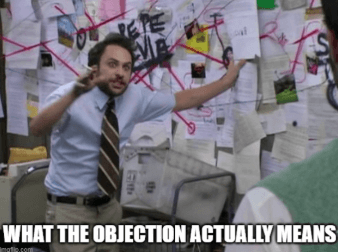
Once you’ve explored the possibilities sitting beneath an objection, the next step is to validate it.
Most of the time, this happens through the conversations you’re already having. You just have to know what to listen for and when to ask clarifying questions.
When I’m working with clients, I use surveys, interviews, and data from their actual best-fit clients because these formats create space for people to say what they never thought to mention before.
The patterns that emerge give you the truth guessing can’t. That’s what makes your messaging feel grounded instead of generic, and helps your audience feel like you’re speaking with them, not at them.
Confirm the patterns that matter
When your messaging reflects the deeper progress people want, your work stops feeling interchangeable or optional. It becomes the thing that helps them move forward in a way they already want.
🔍 When you zoom out, all of this points to something easy to miss: your buyers are making sense of their decisions long before they ever tell you what they’re thinking.
They’re navigating the things that don’t show up on a discovery call transcript but absolutely shape whether they move forward: emotion, past experience, pressure, uncertainty, timing, and identity.
And you don’t need to turn into a psychologist to understand any of it.
You just need to:
- pay attention to how people explain themselves
- consider what else might be happening underneath the words
- validate your assumptions with real conversations
- look for patterns, not single moments
When you do that, messaging becomes clearer and the right-fit clients recognize themselves in what you’re saying.
This is also why competitor analysis matters, not in a “who’s better” sense, but in understanding the comparisons your buyers are already making. The ones they may never tell you about directly, but that shape their sense of risk and readiness.
If you remember one thing, let it be this
The objection you hear is rarely the decision your buyer is actually making. The real insight lives underneath– and when your messaging speaks to that layer, everything else gets easier.
When you’re ready, here’s how I help:
1. Copy Audit: Get a fresh set of eyes on your website, sales page, or key asset. You’ll walk away with a prioritized roadmap of what to fix first and exactly how to fix it.
2.Strategy Session: Not sure what’s working, or what’s not? Get clarity on the problem that’s been spinning in your head. (One client called it “therapy for her brand.”)
3.Done-for-You Messaging & Copy Ready for comprehensive positioning, messaging, and copy that turns strangers into buyers? Let’s talk.
4. Practicing what I preach about meeting buyers where they are: if you’re not ready to work together yet, grab mystory-first case study template for $19. Learn how to turn results into stories that sell.