
Understanding the buyer-seller mindset gap
👋🏻 Welcome to issue 46 of straight-to-the-point insights that turn why they buy into how you sell. (Did someone forward this to you? Subscribe here.)
You’d buy your offer.
You know it’s good.
You’ve got a funnel. A freebie. A CTA that’s clear and to the point.
So… why aren’t more people saying yes?
You’ve done everything right. You’re proud of the work. But (harsh truth incoming): Your brain ≠ your buyer’s brain.
Here’s one of the biggest blind spots in marketing:
You are not your buyer. And when your copy assumes otherwise, it stops working.
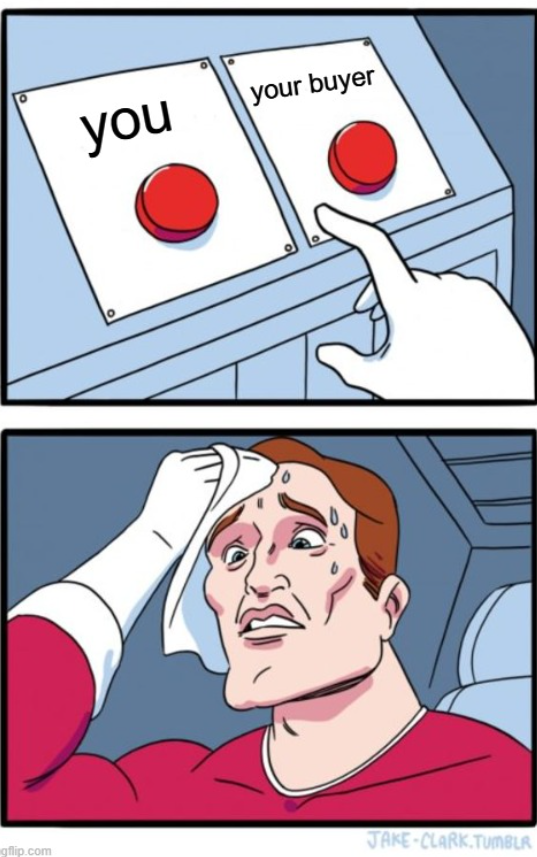
Let’s break that down:
- If you’re a fast decision-maker, you expect your audience to be too.
- If you buy based on gut instinct and trust, you assume they should already know you’re legit.
- If you’d book a call after one post, you wonder why no one else is doing the same.
But your buyers don’t think like you. They don’t buy like you. They’re not on your timeline.
That mismatch? It’s where messaging breaks down and good leads get lost.
5 dangerous assumptions that break your messaging
Here are five assumptions I see show up in copy again and again:
🧠 “If they’re not ready to buy now, they’re not my people.”
(why most buyers need time and that’s okay)
Truth: Most of your audience won’t be ready today.
But that doesn’t mean they won’t ever be. That said, some are ready.
L wasn’t on my email list. She wasn’t following me. She just saw my comment on a mutual connection’s post, noticed I was local, and reached out. We signed a contract within a week. No nurturing needed.
But that’s the exception, not the norm.
Most people? They’re not reaching out after a single post. They’re watching, waiting, and deciding.
🌀 “I already have a funnel.”
(when your sales process serves you, not your audience)
Cool. But who’s it really built for? Your process or your audience’s?
If leads aren’t moving through it or replying to your CTAs, that’s not a coincidence. That’s a clue your funnel doesn’t need more automation, it needs better alignment.
If people are clicking but not converting, ghosting after discovery calls, or ignoring your follow-ups—your copy might be built for the buyer you wish you had, not the one actually reading it.
⚠️ “People are skimming. I need to push the sale fast.”
(why premature CTAs drive buyers away)
Let’s get something clear: if your CTA doesn’t match where someone is in their buying journey, it doesn’t matter how prominently you place it or how compelling it is, it won’t land.
If it feels too soon? It’s not just ineffective, it’s a turnoff.
This isn’t about removing your strongest CTA. It’s about pairing it with the right message, so it doesn’t fall flat. Or worse, drive people away.
📌 “I can’t personalize for everyone.”
(simple ways to meet buyers where they are)
You don’t have to. (Thank goodness. I’d be screwed if you did.) But you can build in small moments of choice and relevance.
- Write headlines that speak to different levels of readiness
- Offer a lower-commitment option alongside your main CTA
- Adjust intros and context instead of rewriting everything from scratch
Personalization doesn’t mean complexity. It means clarity.
🕵️♀️ “I’m not a mind reader.”
(how to understand your buyers without guessing)
You don’t need to be.
Think of it like walking into a bookstore. Some people head straight to the register. Others linger, skim, flip through pages, and wander back later. (It’s me. I browse for hours.) If you stood at the door yelling “Buy now!” at everyone, you’d lose the buyers who just needed a minute.
Instead of guessing, get curious. Watch what they engage with. Then meet them there.
The strategy shift: writing for buyers that need time
- Speak to the ones who are curious, not just committed
- Make the lurkers feel seen
- Use softer CTAs like “read the case study” or “see how it works”
Before and after: transforming your calls-to-action
❌ “Book a discovery call”
✅ “Not ready yet? Here’s a behind-the-scenes look at what a first session actually feels like.”
❌ “Work with me”
✅ “See how I helped [client name] go from X to Y.”
❌ “Download the guide now”
✅ “Curious how to [solve X]? This free guide breaks it down (no signup required).”
(And if all your CTAs are ‘soft’, flip them to include a few for those who ARE ready to book a call, work with you, or download now.)
Because when the right message meets the right buyer at the right time? That’s when it clicks.
When timing and trust align
B had been following me on LinkedIn for months. He’d stalked my website (his words, not mine). He knew he wanted to work with me, but budget was holding him back.
So when I launched the beta for my done-with-you website offer? He jumped in immediately. The timing worked. The offer fit. The trust was already there.
That wasn’t luck. That was the right offer—delivered at the right time to the right person.
That’s not just strategy. That’s alignment.
Some buyers need time. Some just need the right invitation. Your job isn’t to rush the sale. It’s to stay relevant until the decision makes itself.
Until next time,

Stacy
Want help seeing what your buyer actually sees?
- Copy audit: Get a fresh set of eyes (mine 🙃) on your copy to see what’s working and what’s not. Walk away specific, actionable, easy to implement fixes.
- Clarity call: It’s like therapy for your brand. Get expert guidance on positioning, messaging, and conversion-focused copy, or whatever you’ve been spinning your wheels on.