What your customers are actually telling you (and how to use it)
There are two easy-to-make mistakes when it comes to messaging:
- Jumping to tactics without a research-based strategy
- Researching, but collecting the wrong insights
Both create the same problem: you’re writing copy and content without real customer insight.
So you start in the wrong place. Posting more on social, rewriting your website, tweaking headlines, testing offers.
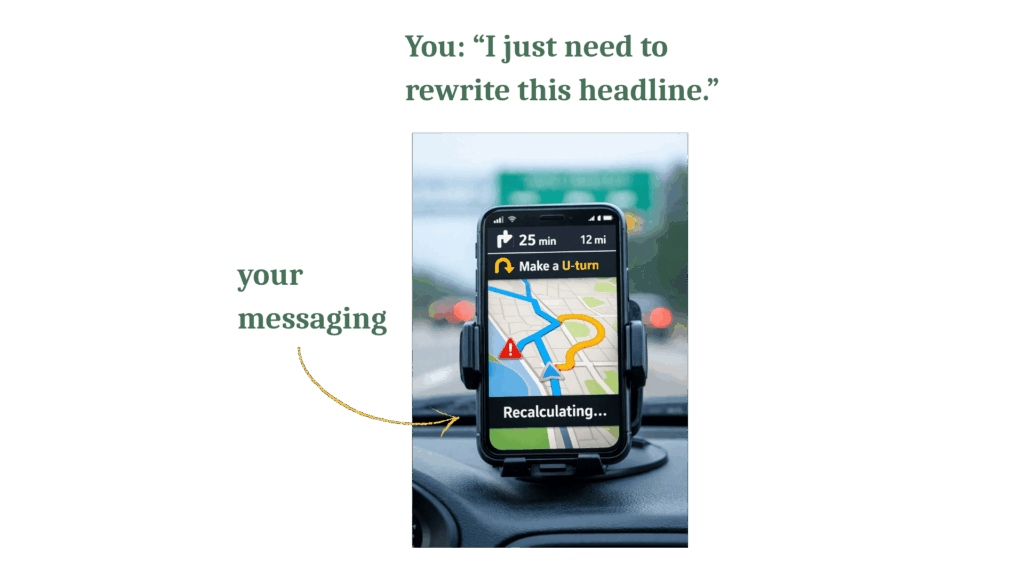
And the messaging underneath all of it is built entirely on assumptions.
What we think our clients want, what we think they care about, and—this one gets us every time—what we think makes us different.
The problem is buyers don’t make decisions based on our assumptions. They make decisions based on their own thinking.
If you want messaging that actually connects, you have to start with evidence. Today I’m breaking down the two kinds of evidence you need and how to translate them into messaging that resonates, builds trust, and moves people to action.
👋🏻 Welcome to issue 90! Did someone send you? Join my other smart subscribers here.
Two types of customer insights (and why mixing them up kills conversions)
One of the most effective things you can collect is Voice of Customer (VoC) language, the actual words people use when they describe their problem, explain what they’ve tried, and reflect on the outcome. This is the raw material for your messaging.
I wrote about where to find this and how to collect it here, and what to look for here.
But once you start gathering it, a new question shows up: What do I actually do with all of this?
Because not all insights do the same job. At a high level, there are two categories:
- Pre-decision language: what someone was thinking when they decided to buy
- Post-decision language: how they describe the experience after
You need both. And they are not interchangeable.
The testimonial trap: why post-decision language misleads your buyers
For an example, let’s use part of Andie Huber’s testimonial after a clarity call:
“As entrepreneurs, we are so blind to our own sh*t. Stacy helps you dig through all the mess and actually uncover your unique qualities that make your business different, and how to properly communicate that to your ideal customers.
Before booking with Stacy, I was so lost when trying to figure out what differentiators I should focus on, and how to even begin communicating them. After our strategy session, I left with so much clarity and actionable next steps. I saved so much time and SO many headaches by just booking a strategy call.”
Read that first line. “Blind to our own sh*t.” It sounds like what she was feeling when she decided to book, doesn’t it?
It wasn’t.
She wrote that after working through it with me. Before the call, she didn’t have that language. She just knew something wasn’t working. She couldn’t name what made her different and couldn’t figure out where to start.
The clear framing came later, once she could see it from the outside.
That’s exactly what makes post-decision language so tricky. It doesn’t just describe the outcome; it retroactively sharpens how the problem felt. By the time someone writes a testimonial, they’ve already done the work of making sense of where they were. Your buyer in the before stage hasn’t done that yet.
They’re not thinking “I’m blind to my own differentiators.” They’re thinking:
- “We’ve rewritten this three times and it still doesn’t feel right.”
- “People are interested, but not the ones I actually want to work with.”
- “I know our work is strong. It’s just not coming across.”
That’s pre-decision language.
Post-decision language sounds like:
- “Fresh lenses on my business and offers.”
- “So much clarity and actionable next steps.”
- “Far less overwhelming.”
One helps your buyer feel seen before they’re ready to move. The other reassures them that people like them made a smart decision.
You need both.
When you build your messaging from the second one, that’s where things go awry.
You end up talking like it’s already solved, like they’re further along than they are. And they’re still sitting there thinking… I’m not even sure what’s wrong yet.
How to map customer language to the full buyer journey
Instead of applying this to your whole business, pick one offer. I’ll use my clarity calls as an example.
I went back to pre-purchase language: onboarding forms, emails, DMs… anything from before someone bought. Here’s some of what came up:
- “I don’t know if this is the right offer anymore, but I don’t know what to change.”
- “This used to sell easily and now it’s just not landing the same.”
- “People are interested, but they’re not the ones I actually want to work with.”
- “Every time I open my mouth to explain what I do, I stumble over my words.”
- “People say the site looks great, but it’s not converting.”
Then I looked at post-purchase language—testimonials, follow-up emails, anything shared after they’d gone through the experience:
- “I finally have clarity on how to talk about what I do.”
- “She got to the real problem fast.”
- “My messaging actually reflects the depth of my work now.”
- “I can already see the impact in my leads and how people are responding.”
Now I have the full arc: where people struggle before, what they’ve already tried, what they actually want, what changes after.
The pattern? Most came in thinking they had a content or copy problem. What they were actually describing was a clarity or positioning problem. And that’s exactly why understanding what they were experiencing when they decided to buy is so critical. That’s where your next buyer will see themselves in your copy.
How to turn VoC research into copy that converts
Once you have both sets of language, the next step is making the connection visible to your audience.
Before I write a single word of copy, I look at the pre-decision patterns and ask: what does this person actually need to hear?
The strategy
For my clarity calls, here’s what the data told me.
- This isn’t a tactics problem. The offer has shifted and the messaging hasn’t caught up.
- Getting interest from the wrong people isn’t bad luck. It’s a signal.
- The site sounding/looking good but not converting isn’t a writing or design problem. It’s a clarity problem.
- You shouldn’t have to explain your work on every call. Your messaging should do that before you ever get on one.
That’s the messaging, the translation. It’s what every piece of copy needs to communicate regardless of where it lives or what format it takes.
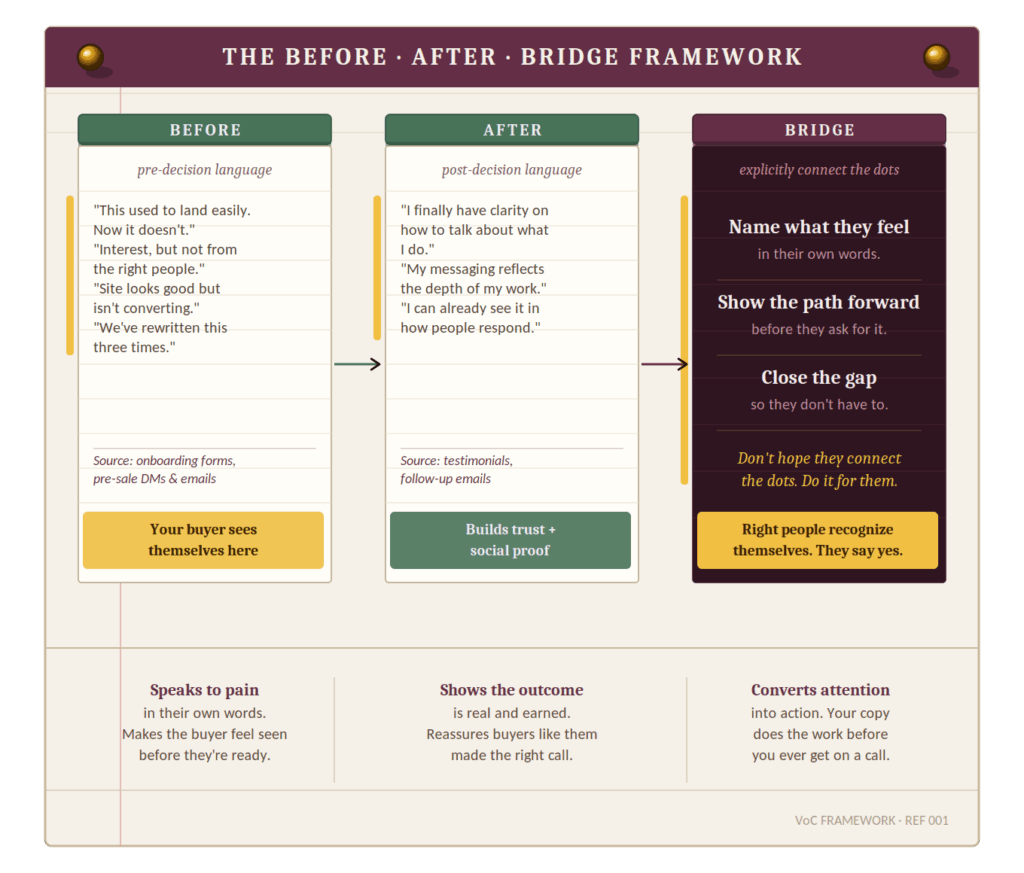
From there, I use a simple copywriting framework called the Before-After-Bridge to structure how I say it.
Before is built from pre-decision language.
After is built from post-decision language.
The Bridge is how you get them from one to the other, and it’s where you do the work of explicitly connecting the dots.
The execution
Here’s what this might look like applied directly to copy using the Before, After, and Bridge pulled straight from the VoC patterns above:
(I wrote this just for the sake of this newsletter. Yes, it needs a little zhuzhing up before it goes into the wild.)
Example one-pager:
Stop spinning your wheels
In 60 minutes, find out exactly why your messaging isn’t landing and walk away with a clear plan to fix it.
You’ve tweaked the offer, redone the site, and rewritten the copy more times than you can count.
But the right people still aren’t finding you, or recognizing you as the easy yes when they do.
Sales conversations take more explaining than they should. The work is good; it’s just not coming across that way.
When you’re buried in the weeds, it’s damn near impossible to see the garden. That’s what a Clarity Call is for.
In 60 minutes, we step outside your business and find exactly where your message is losing the right people. Then you walk away knowing what to say, who to say it to, and what to fix first.
You leave with:
- A clear read on why the wrong people are responding and what to say to attract the right ones
- The real reason your copy isn’t converting (it’s rarely what you think)
- A prioritized action list so you know exactly what to tackle first
Because the answer isn’t another rewrite.
→ It’s knowing what to fix before you touch a single word.
“She asked me the hard questions, the right questions, and helped me nail my positioning in a way that actually made sense for my business. She didn’t just hand over generic advice. She gave me clear, actionable steps that made an immediate impact. If you’re feeling stuck or unsure how to position yourself, Stacy’s the person you want in your corner. She’s sharp, strategic, and knows how to cut through the noise.” – Melissa Glick
Let’s figure out what’s off.
Fix your messaging before you scale your marketing
When your message matches how your buyers are actually thinking at the moment they decide, you’re translating what’s already there into something they immediately recognize as their own problem. They stop working to understand what you do. They just see themselves in it.
And when people feel seen and understood, saying yes gets a lot easier.
Until next time,

Stacy
P.S. If any of this sounded familiar, maybe it’s time to finally book that call.
When you’re ready, here’s how I can help:
1. Looking for the perfect place to use that pre- and post-decision VoC? Earn trust with stories that sell. Grab my story-first case study guide.
2. Copy audit: Get a fresh set of eyes on your website, sales page, or key asset. You’ll walk away with a prioritized roadmap of what to fix first and exactly how to fix it.
3. 1:1 positioning, messaging, & copy projects Curious whether it’s a good fit? Let’s chat. (Don’t worry. It’s just a conversation. No pressure or hard pitch.)
4. (ICYMI) Clarity call: Not sure what’s working, or what’s not? Get clarity on the problem that’s been spinning in your head. (One client called it “therapy for her brand.”)