
The Messaging Mistake That Killed Our Event Registration (And Shows Up in Your Business Too)
A marketing strategist and a messaging strategist walk into a bar.
The joke?
Well, it’s what happened when they spectacularly failed to lure attendees to an event they were co-hosting. Because of the messaging. 🙄
This isn’t just a sob story. There’s a lesson in it for you too.
The mistakes we made?
They’re the same ones we see businesses make every day. Only in those cases, the stakes are usually much higher.
This is a story of poor positioning, the assumptions we make, and ignoring the cardinal rule of marketing: People care about one thing.
→ “What’s in it for me?”
How a newsletter reply turned into a marketing event (and a lesson)
It started with a reply to one of my newsletters.
I had written about a piece of marketing advice I absolutely hate: the idea that you should regularly clean up your email list by scrubbing off the “tire kickers.”
The advice usually goes something like this: “If they’re not converting, they’re hurting your list health.”
I strongly disagree. Many of the people in your audience who aren’t ready today are potential future buyers. (Or amplifiers of your message or possible collaborators.)
Adriana felt the same way. She replied, we started talking, and eventually said: This would make a fun LinkedIn Live.
Our idea? Two Truths and a Lie: Marketing Edition.
We’d pick three common marketing takes and unpack the assumptions behind them. Here’s what we landed on:
✔ Buyer journeys are not linear. (true)
✔ Competent marketing is not enough. (true)
✔ To keep your list healthy, boot off the tire kickers. (BS)
The goal was to help people think more critically about the advice they follow and the assumptions shaping their marketing.
We just made one small (read: massive) mistake and never actually communicated that.
👋🏻 Welcome to issue 89! Did someone send you? Join my other smart subscribers here so you don’t miss the next one.
Why we had 40,000 followers and only 6 event registrants
Two days before the event, six people were registered. (Two of them were us. 😬)
We have a combined audience of over 40,000 people, so obviously reach shouldn’t have been an issue.
Of course, we immediately cursed the algorithm. It’s always easier to blame something external when things don’t work out, right?
But it took about thirty seconds of looking at the event description to realize that wasn’t the issue. The problem was the messaging.
If anything, the bigger realization was this: If two people whose entire job revolves around marketing can make this mistake…
…it’s incredibly easy for anyone else to make it too.
That’s when I decided to write this newsletter.
Here’s the graphic we used to promote the event.
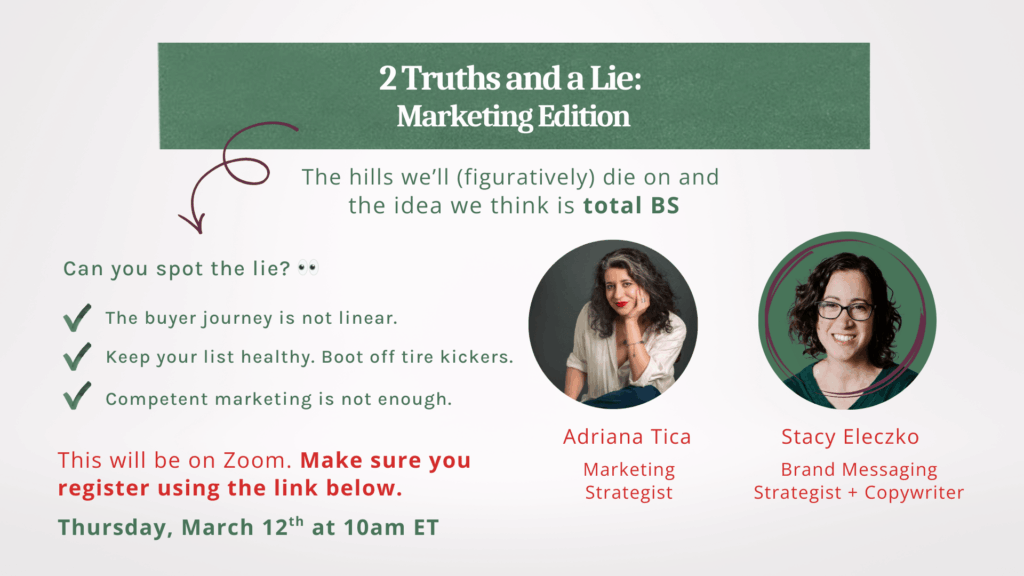
Looking at it now, it basically says:
Two marketers and three opinions. Come watch us chat.
What it doesn’t clearly answer is the question every potential attendee is wondering:
→ Why should I spend an hour of my time on this?
Outcome vs. conversation: how event positioning affects attendance
Then I pulled up the graphic from another event we’d done together.
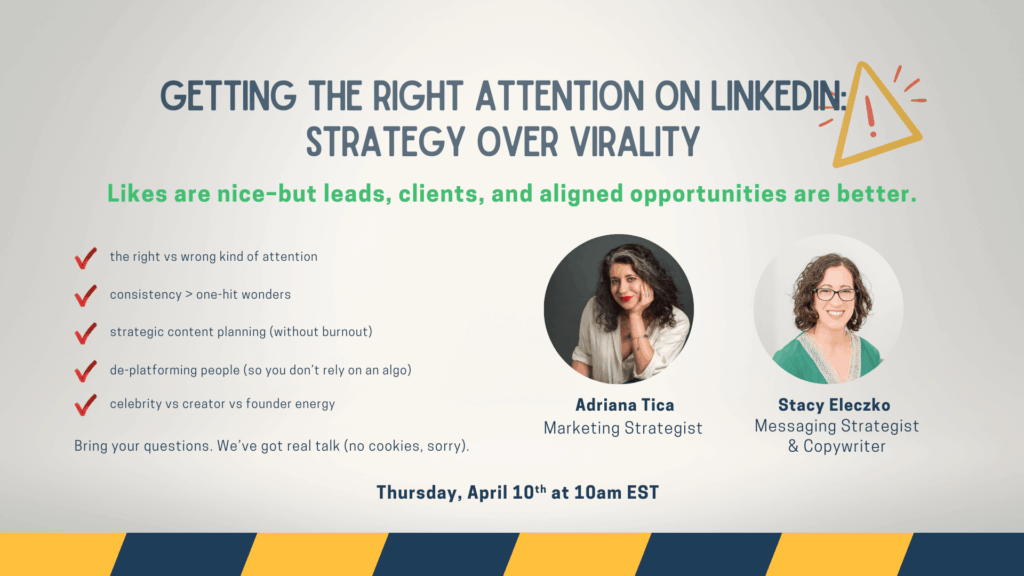
The difference jumped out immediately.
The headline promised a result and the bullets told people exactly what they would walk away understanding.
The entire thing was framed around a problem business owners actually care about: attracting leads, clients, and aligned opportunities.
Now compare that to “Two Truths and a Lie”.
We positioned it as two marketers debating three spicy marketing takes instead of calling out advice that might be undermining your growth.
One event promised an outcome; the other event promised a conversation.
And most people don’t show up for conversations. They show up for solutions.
The mistake behind the mistake
If you’re reading this thinking, how did two people whose entire job is marketing miss this?
Fair question.
This is a classic example of not taking your own medicine.
Sometimes I feel like a damn parrot.
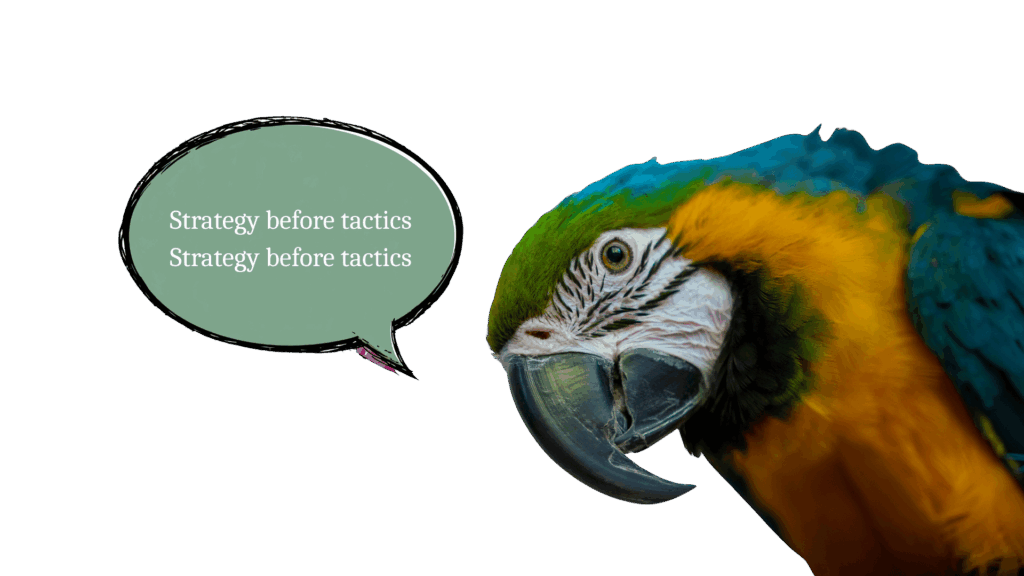
And yet, what did I do?
Well, not strategy before tactics.
Whether you’re thinking about an entire brand or a single offer, it has to start with positioning: who is this for and what problem does it solve?
This was where we first went wrong. Yes, we talked about it at the surface-level, and I’m sure we each had our own ideas, but we didn’t clearly spell it out.
If you don’t have solid positioning, you can’t move on to the next layer—messaging.
This is where you identify the messages your audience needs to hear to know you understand their problem.
Messaging is the translation layer between strategy and execution. It’s also the one we skipped entirely. (Yep, I get the irony.)
Instead, we went straight to tactics: copywriting. And since I’m laying it all out, I missed the mark here too. (This is getting more and more painful to write.)
When you’re close to the work, it’s easy to assume people already see the value, understand the problem, or know why the conversation matters.
But your audience doesn’t see what you see.
(the curse of knowledge)
One of the most basic rules of copy is answering the reader’s question: what’s in it for me?
Which is why good copy usually does five things:
– shows the benefit
– centers the reader
– addresses the problem
– creates emotional relevance
– tells people what to do next
Here’s how we did.
❌ Benefits over features
Not only did we not talk about what they gain, we didn’t even really address what they get. We just listed 3 topics of conversation.
❌ Customer-centric focus
We made this one all about us: The hills we’ll (figuratively) die on and the one we think is total BS.
❌ Problem-solving
Nope.
❌ Creating an emotional connection
Not so much.
❌ Compelling CTA
I’ll let you judge. Does this tell you how joining us moves you toward solving your problem? “This will be on Zoom. Make sure you register using the link below.” (This is a rhetorical question btw.)
Our report card? 0/5
How this shows up in real businesses
Now, you might be thinking: Okay, but that was an event. But this same mistake shows up in businesses all the time.
Usually when everything else seems to be working.
You have a strong, proven offer. Clients who work with you get real results. The people who’ve experienced your work understand the value immediately.
But when you talk about it publicly, something doesn’t quite click. People seem interested, but they’re not moving forward.
This is where most people assume the problem is visibility, but often the real issue is simpler.
The value becomes obvious after someone works with you. It just isn’t obvious before they do.
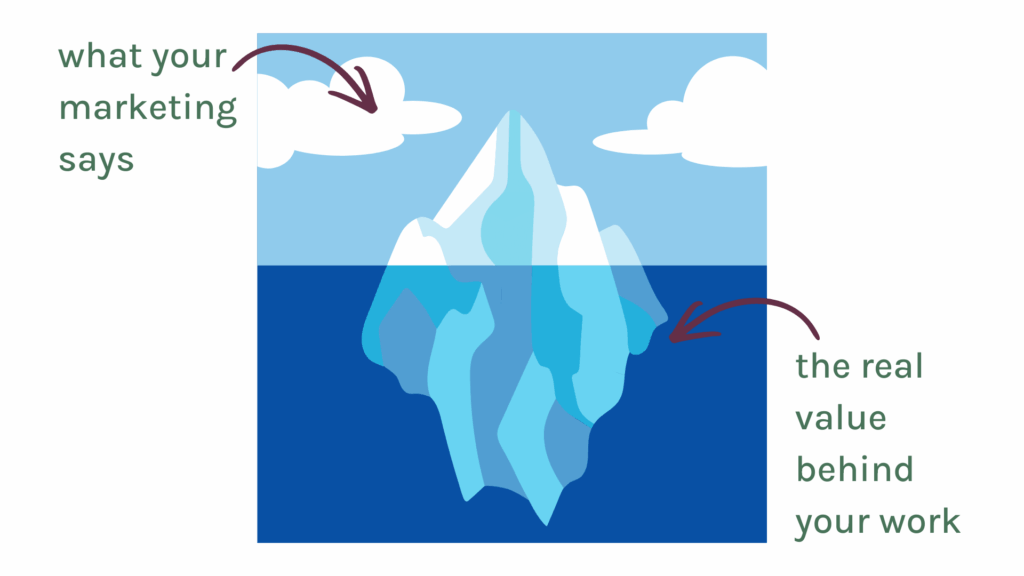
Referrals hide this problem beautifully. Someone else vouches for you, the value is implied, and the client shows up already convinced.
But referrals have a ceiling. And when you try to grow beyond them, you realize something uncomfortable: The message that’s been living in other people’s mouths has never actually been written down anywhere.
The tell is usually this: You’re describing the work instead of the result.
- A proposal that walks through your process instead of the problem you’re solving
- A service page that lists what’s included instead of what changes for the client
- An event description that promises a conversation instead of a result
Which brings it back to us.
“Two Truths and a Lie” described the activity. What it never clearly said was what someone would walk away knowing.
That some of the advice they might be following right now could actually be undermining their growth. That in one hour, they’d walk away with a sharper filter for the marketing advice that actually applies to their business.
That’s the version that would’ve earned clicks.
Instead, we handed people a conversation and assumed they’d figure out why it was worth an hour of their time.
They didn’t. And honestly? We deserved that.
Assumptions are where good marketing goes to die.
A simple litmus test for service-based businesses
If you have a solution to the problem that’s keeping someone up at night, you owe it to them to make that crystal clear.
So here’s where to start: Pick one place where you’re currently describing your work.
- your homepage headline
- an offer description
- a workshop or event you’re promoting
- the About section of your LinkedIn profile
Now ask yourself a few honest questions. Or even better, ask someone who has no idea what you do to take a look. At first glance, consider:
- Am I explaining what I’m doing or why someone should care?
- Is this about them, or about me?
- Does it explicitly tell them what’s in it for them, or did I just assume they’d figure that out?
❌ “Six weekly calls and templates” explains the format.
✅ “Walk away with a clear plan for attracting the right clients” explains the value.
❌ “Join us for a conversation about marketing myths” explains the activity.
✅ “Three pieces of marketing advice that could be quietly undermining your growth” explains the outcome.
If the value isn’t obvious in the first few seconds, people don’t try harder to figure it out. They move on.
That means someone sitting in your audience with a very real problem you solve, someone ready to buy, doesn’t even know to put you on the short list of options to consider.
One more thing
If this story felt a little too familiar, it might be a sign there’s a messaging gap somewhere in your business.
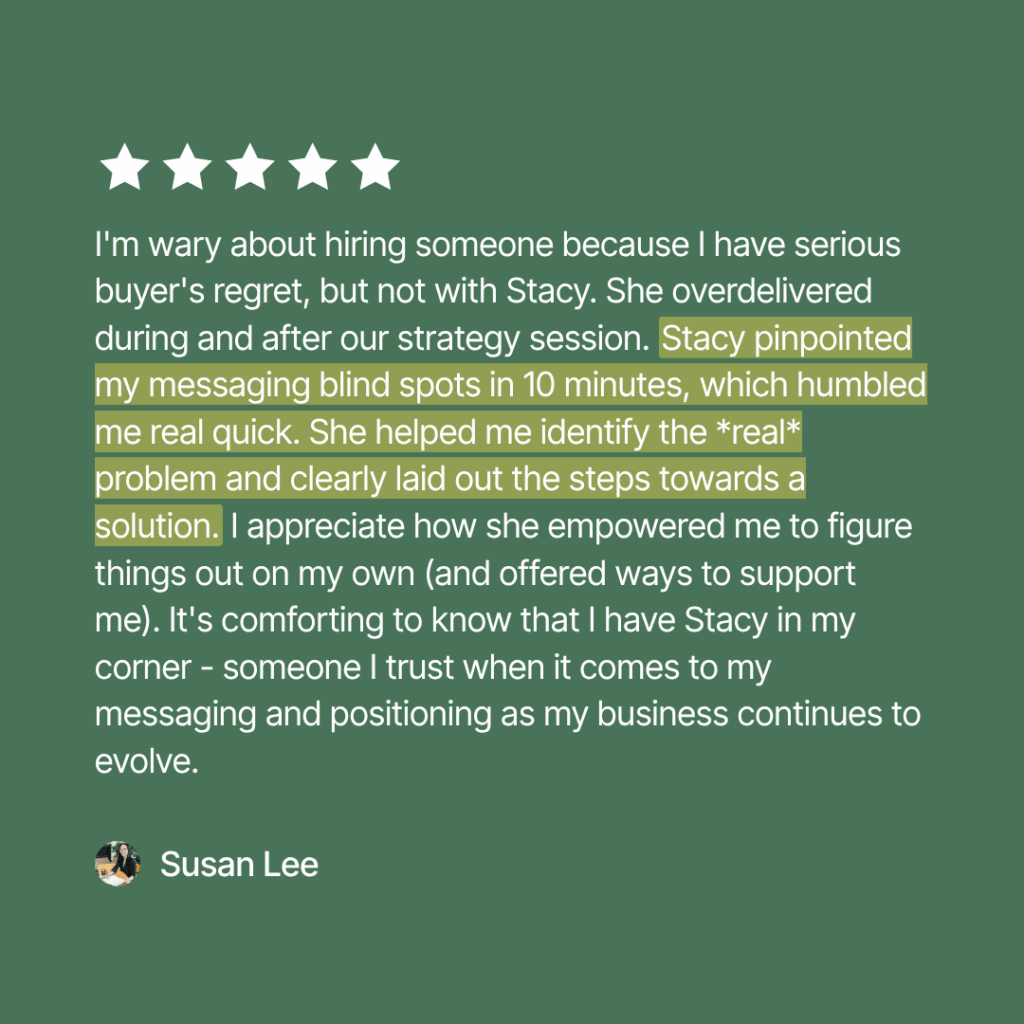
That’s exactly what my clarity calls are designed to uncover. In one focused session, we look at how you’re currently positioning your work and where the message might be getting lost.
Sometimes the strategy is solid and the messaging just needs some tweaks, and sometimes (honestly, most times) the issue runs a little deeper.
Either way, you leave with clear next steps instead of more guesswork.
If you want to take a closer look at your messaging (or anything else you’re spinning your wheels on), you can schedule a clarity call here.
Until next time,

Stacy
1. Copy audit: Get a fresh set of eyes on your website, sales page, or key asset and walk away with a prioritized roadmap of what to fix first and exactly how to fix it. *This offer is getting a complete overhaul. Book now if you want to grab it at this price.
2. Case study guide: Testimonials are great. Even better? A relatable case study that tells the story of a client win and earns trust. Only $19.
3. Clarity call: Not sure what’s working, or what’s not? Get clarity on the problem that’s been spinning in your head. (One client called it “therapy for her brand.”)
4. 1:1 positioning, messaging, & copy projects Curious whether it’s a good fit? Let’s chat. (It’s just a conversation. No pressure or hard pitch.)