
You’ve probably heard people say, “Messaging shouldn’t be this hard.” (Maybe you’ve even said it.)
Every time, I want to slide them a chair, pour a coffee, and say: Really? Tell me again why it shouldn’t be.
Because if we’re honest, most businesses aren’t struggling with messaging because they’re “too close to their own work” or because they “aren’t creative enough.”
Although sometimes, yes, the expert trap sneaks in. When you know something deeply, your brain fills in the gaps your audience can’t see. It happens to all of us.
But for most people, messaging feels hard for a much more grounded reason.
It sits on top of a long chain of decisions.
Decisions about value, audience, positioning, differentiation, timing, expectations, beliefs, and outcomes. And many of those decisions haven’t been revisited in years because the business kept moving and the message… didn’t.
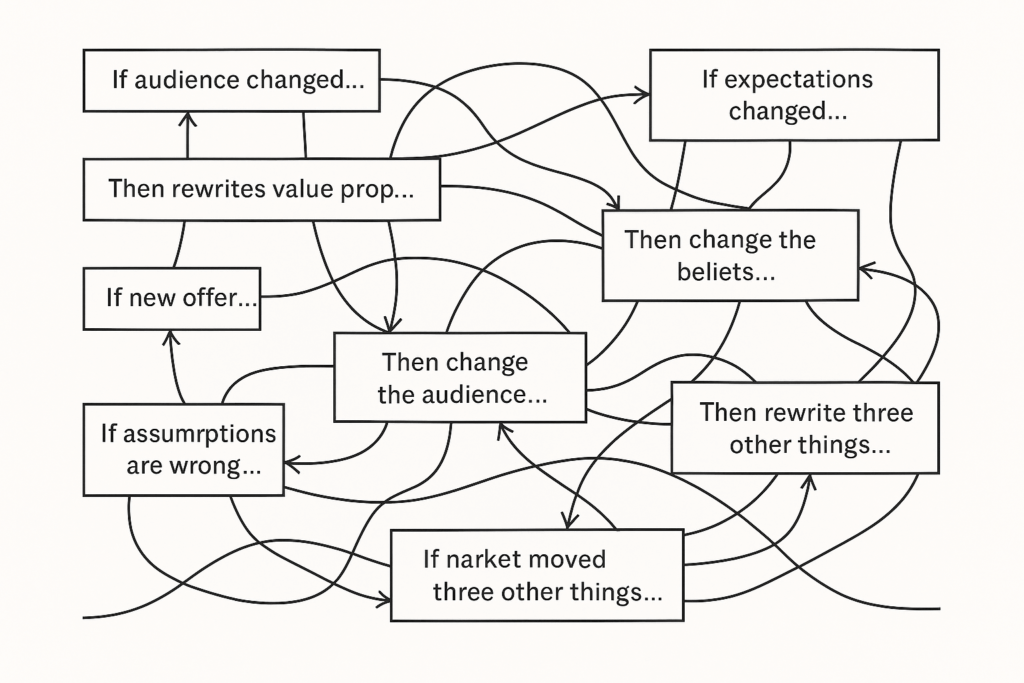
There’s also the reality we don’t name often.
Some of us actually do know how to do this work. We have the experience, the instincts, the strategic depth. But we’ve grown past the point in our businesses where we have the time, space, or mental runway to do it the way it deserves to be done.
Messaging is real work. It needs attention. Most of us don’t have any attention left.
Yet we still expect the message to resonate with the right people, attract aligned clients, and convert.
All without the strategy underneath.
Messaging is complex because it is the moment where positioning, insight, voice, and value meet.
So if it feels hard, that’s not a sign you’re doing something wrong. It’s a sign you’re doing real strategy work instead of shortcuts.
Which brings us to the place where the cracks start to show: positioning.
👋🏻 Welcome to issue #78! Each week I share insights that turn why they buy into how you market (and sell). Not subscribed yet? Click here.
The first place your messaging gets derailed
Positioning is the part most people skip because it doesn’t feel urgent. No one wakes up thinking, “You know what I should revisit today? The core assumptions that shape how my business shows up in the market.”
We’re all busy serving clients, delivering work, and keeping things moving.
But suddenly the story that used to fit doesn’t anymore. Your business evolved and the market did too. Your messaging? Not so much. That gap creates friction you can feel when you’re trying to articulate what you’re known for now.
Because when that shift happens, the message stops being a translation of your value and becomes a guess at what might land.
Clarity is helpful, but it only resonates when people understand who you are in the context of what they need.
Positioning is what makes it possible for your message to actually resonate.
Are you listening to the right people?
Once your positioning is clear, the next stumbling block is usually this: you’re working with the wrong inputs.
Most people assume they’re gathering audience insight, but what they’re actually gathering is information from a mix of:
- clients they served three years ago
- people who liked a post but would never buy
- referrals from folks who don’t really understand what they do
- “ideal clients” that exist more in aspiration than reality.
Real audience insight is specific.
It reflects the people who buy now, not the ones from an outdated or future version of your business.
And even then, it’s rarely one audience.
You have buyers. You have amplifiers who influence the decision. And there are people who will never hire you but still shape how others see you.
If you’re pulling insights from all four without separating who is who, it becomes impossible to write a message that resonates consistently. You’re blending motivations, timelines, emotional triggers, and decision criteria that shouldn’t be mixed.

This is why so many founders feel confused. They think they have a “messaging problem,” but what they really have is a data problem. When your inputs don’t match the audience you’re trying to reach, the messaging can’t match either.
When your insight is clean, meaning you know who you’re listening to and why, the entire picture changes.Your message naturally reflects the conversations your audience is already having, and that’s when they’re ready to listen.
The audience mix-up
Once you clean up your inputs, there’s another layer most people overlook: the insights don’t all belong to the same audience.
A lot of messaging gets muddled because people treat every piece of feedback, comment, hesitation, question, or “I’m thinking about this” as if they’re coming from one singular group.
They’re not.
You have:
- decision-makers
- end users
- people who influence the decision
- people who will never buy but absolutely shape perception
- people who hired you once but aren’t aligned with where you’re heading now
Each group cares about different things.
They have different risks, goals, pressures, timelines, and expectations, and are making decisions for different reasons.
When you blend all of those perspectives together, you lose the clarity you need to speak to any of them well. Your messaging becomes either overly broad or oddly specific in ways that don’t match the people you’re actually trying to reach.
This is how mixed signals happen.
What each one cares about isn’t interchangeable and shouldn’t inform the same message. And they definitely shouldn’t inform the same stage of the conversation.
When you start separating who’s saying what and why, patterns emerge. That’s when your messaging is clear and resonant.
Because aligned messaging isn’t about writing something that everyone understands; it’s about writing something the right person immediately recognizes as meant for them.
What buyers need
(You may be noticing a theme by now.)
So now you’ve found the patterns and the throughlines, here’s what often goes wrong next.
Even when you’re speaking to the right audience, the message has to match where someone is in their decision process.
| Stage | What it means | What they need |
| Problem unaware | Trying to understand their problem | They need language that helps them name what they’re experiencing. They’re not ready for proof or process, they’re trying to understand themselves. |
| Problem aware | Deciding whether it’s worth addressing | They’re weighing whether the problem matters right now. They need context and perspective, not a pitch. |
| Consideration | Comparing approaches | They’re comparing solutions and need to know the real differences between perspectives and the shifts created by your approach. |
| Decision-making | Evaluating you specifically | They need alignment. Does your voice feel like a fit? Do you understand how they think and decide? Do they trust the way you see the problem? |
These aren’t stages. They’re human checkpoints–places where people pause, think, and decide what to make of what they’re seeing.
When you sound like an echo chamber
Even if you get everything else right, there’s still one more layer that decides whether your message connects.
Your audience has to hear themselves in your messaging. But they also have to hear you.
This is where a lot of messaging gets off track. People swing to one extreme or the other.
Some write entirely in their audience’s language. It’s relatable, but it sounds like everyone else. There’s no point of view, no edge, no sense of who they are.
Others write entirely in their own voice. It’s expressive, but it doesn’t reflect the way their audience thinks, decides, or describes their struggles. So it doesn’t move the people who are actually making the decision.
Effective messaging sits in the overlap.
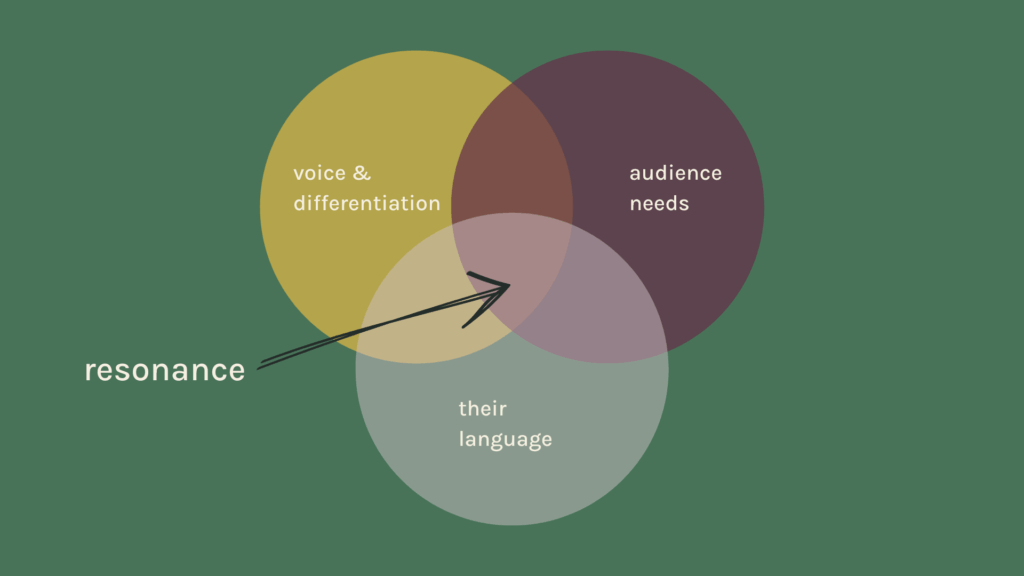
Your audience recognizes their thoughts, fears, questions, hopes, and language. And at the same time, they get a clear sense of your perspective, your approach, and the way you see the world.
That blend builds trust faster than any clever line or polished hook. It signals: “I understand how you think. Here’s how I can help you think differently.”
When those two voices, theirs and yours, finally line up, your messaging doesn’t feel forced or effortful. It feels inevitable.
When it all comes together
Zoom out and you can see why messaging feels harder than it looks from the outside.
It’s not one thing. It’s all of it.
- clear positioning
- clean insight
- knowing which audience you’re actually listening to
- understanding what someone needs in the moment they’re making sense of their problem
- blending their voice with yours in a way that feels honest.
Messaging isn’t a line you write. It’s the outcome of every strategic decision underneath it.
If you need your messaging to finally reflect the depth of your work, I’m here when you’re ready.
Until next time,
Stacy
When you’re ready, here’s how I help:
1. Copy Audit: Get a fresh set of eyes on your website, sales page, or key asset. You’ll walk away with a prioritized roadmap of what to fix first and exactly how to fix it.
2.Strategy Session: Not sure what’s working, or what’s not? Get clarity on the problem that’s been spinning in your head. (One client called it “therapy for her brand.”)
3.Done-for-You Messaging & Copy Ready for comprehensive positioning, messaging, and copy that turns strangers into buyers? Let’s talk.
4. Practicing what I preach about meeting buyers where they are: if you’re not ready to work together yet, grab mystory-first case study template for $19. Learn how to turn results into stories that sell.